UAE businesses operating through VAT groups need to distinguish between intra-group transactions and transactions with customers, suppliers and related companies outside the VAT group.
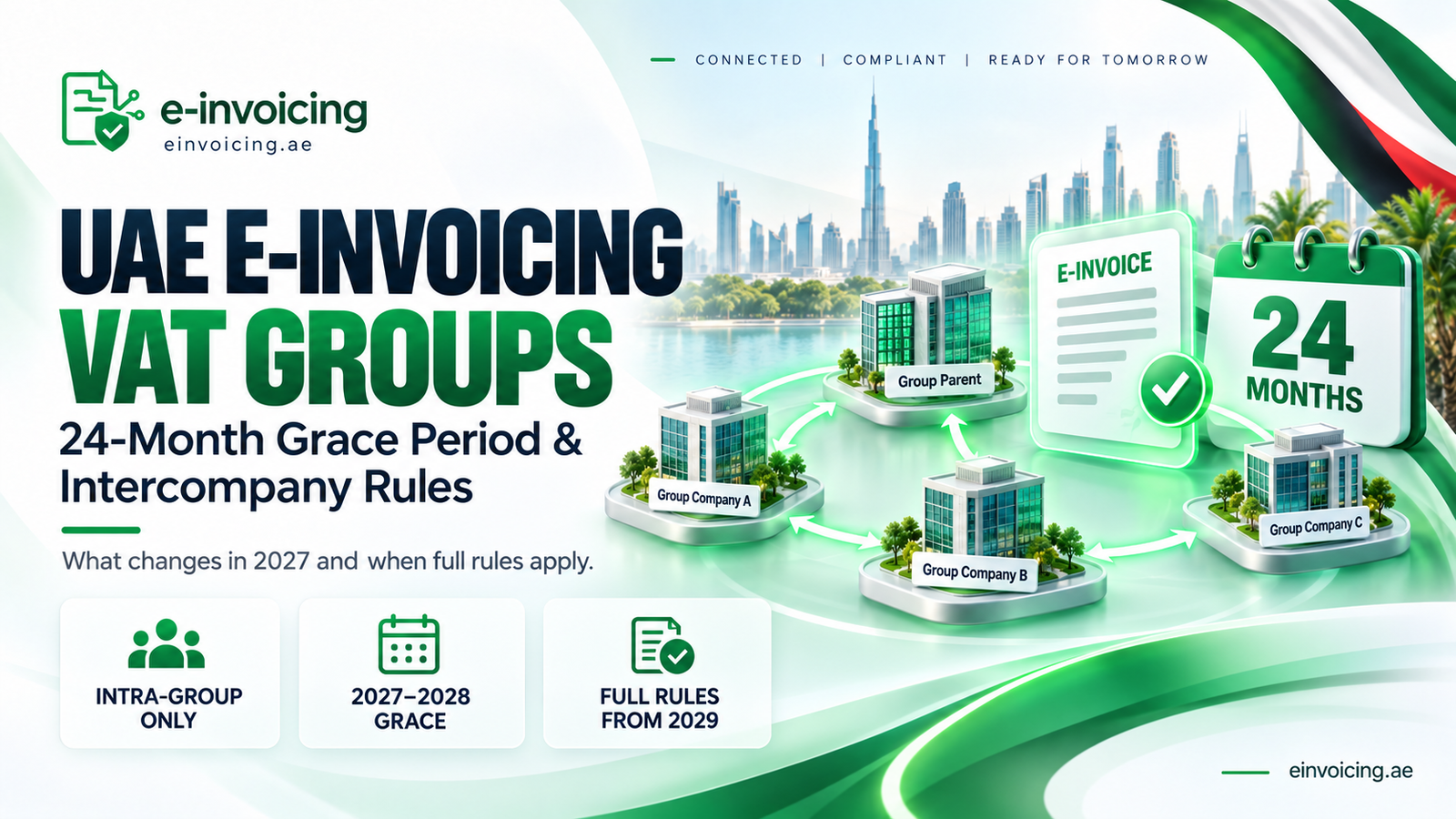
The Ministry of Finance (MoF) Electronic Invoicing Guidelines V1.1 confirm that Business Transactions between members of the same VAT group remain within the UAE Electronic Invoicing System. However, implementation of e-invoicing for those intra-group transactions is deferred for 24 months from 1 January 2027.
This is a timing relief, not a permanent exemption. External transactions continue to follow the normal rollout timetable, and VAT groups should use the grace period to prepare member-level data, ERP logic and intercompany processes.
UAE E-Invoicing for VAT Groups — At a Glance
Question | Answer |
Are intra-VAT-group transactions in scope? | Yes |
When does the grace period start? | 1 January 2027 |
How long does it last? | 24 months |
Does it cover external transactions? | No |
When do intra-group requirements apply in full? | After the grace period, in accordance with the applicable mandatory implementation phase |
What Are the UAE E-Invoicing Rules for VAT Groups?
Business Transactions between members of the same VAT group are in scope for UAE e-invoicing. Section 6.3.2 of the MoF Electronic Invoicing Guidelines V1.1 makes clear that they are not excluded solely because they are intra-group.
For VAT purposes, the Federal Tax Authority treats a registered VAT group as a single taxable person. A tax group receives one VAT TRN, submits one VAT return, and transactions between group members are generally disregarded for VAT purposes.
For e-invoicing, however, qualifying Business Transactions between those members remain within scope. The 24-month relief postpones implementation; it does not permanently remove those transactions from the system.
For the wider transaction scope, see our UAE e-invoicing scope and exclusions guide.
How Does the 24-Month Grace Period Work?
The grace period applies to Business Transactions carried out between members of the same VAT group and begins on 1 January 2027.
Period | Treatment |
1 January 2027 to 31 December 2028 | E-invoicing implementation is deferred for qualifying intra-group Business Transactions |
After the grace period | E-invoicing requirements apply in accordance with the applicable mandatory implementation phase |
The key point is that the relief changes when compliance is required, not whether intra-group transactions ultimately fall within the Electronic Invoicing System.
Which Transactions Qualify for the VAT-Group Grace Period?
The relief applies where both parties are members of the same registered VAT group and the transaction is a Business Transaction within the e-invoicing framework.
Examples may include management-service recharges, shared-service charges, internal IT or administrative charges, inventory recharges and other genuine business transactions between members.
Group membership should be confirmed at the transaction date, especially where entities join or leave the VAT group.
Which Transactions Do Not Receive the VAT-Group Grace Period?
Being related, sharing a shareholder or belonging to the same corporate group is not enough.
Transaction | Treatment |
Company A → Company B, both in the same VAT group | Yes — 24-month VAT-group grace may apply |
Company A → related company outside the VAT group | No — normal scope and implementation rules apply |
VAT-group member → unrelated UAE customer | No — normal rules apply |
External supplier → VAT-group member | No — normal supplier and recipient rules apply |
UAE VAT-group member → overseas group company | No VAT-group grace — assess the cross-border transaction separately |
This distinction matters for groups with subsidiaries, joint ventures or overseas related parties outside the same UAE VAT group.
Does the Grace Period Delay External E-Invoicing Obligations?
No.Transactions with customers and suppliers outside the VAT group remain subject to the normal UAE e-invoicing implementation timetable.
For an in-scope Person with Revenue of AED 50 million or more, the ASP appointment deadline is 30 October 2026 and mandatory implementation begins on 1 January 2027. For an in-scope Person below AED 50 million, the corresponding dates are 31 March 2027 and 1 July 2027.
A VAT group can therefore have two implementation tracks: external transactions may require e-invoicing in 2027 while qualifying intra-group transactions remain under the temporary grace period.
Is the AED 50 Million Threshold Tested at VAT-Group Level?
The implementation rules define Revenue by reference to the gross income of the relevant Person during its most recent Accounting Period.
VAT-group membership should therefore not be treated as an automatic instruction to use combined VAT-group turnover for e-invoicing phasing. The correct legal Person, its Revenue and its applicable phase should be assessed.
This is particularly important where group members differ materially in size. Do not assume that one member automatically falls into the first implementation phase merely because another group member exceeds AED 50 million.
Where the threshold treatment is unclear for a particular structure, obtain entity-specific advice or clarification from the competent authority.
Does Each VAT Group Member Need Separate E-Invoicing Onboarding?
Yes. MoF guidance treats e-invoicing identification and onboarding at member level.
This differs from VAT reporting, where the VAT group operates under one VAT TRN through the representative member. The FTA confirms that a tax group is registered as a single taxable entity for VAT and uses one VAT TRN.
For e-invoicing, member-level identifying data is required. The member’s TIN is used for its electronic invoicing identification and Peppol Participant Identifier, rather than simply using the representative member’s VAT TRN for every entity.
The MoF mandatory-fields guidance also distinguishes seller and buyer tax identifiers from their electronic addresses and participant information.
Must All VAT Group Members Use the Same ASP?
No. Group members may be onboarded with different Accredited Service Providers.
However, using one ASP across the group may simplify integration, support, governance and reconciliation where that provider is suitable for all entities.
Businesses should verify the provider’s current MoF status and technical capability. Our UAE ASP accreditation rules guide explains the current provider framework.
How Should Intercompany Transactions Be Classified?
Group finance teams should create a transaction matrix before configuring ERP rules.
Transactions Within the Same VAT Group
Identify genuine Business Transactions between entities that are members of the same VAT group at the transaction date. These are the transactions potentially covered by the grace period.
Related Companies Outside the VAT Group
Transactions between related companies outside the same VAT group do not receive the concession. They should be assessed under the normal e-invoicing rules.
For example, management fees from a UAE holding company to a subsidiary outside its VAT group should not be treated as grace-period transactions merely because the companies share ownership.
Transactions with Third Parties
Sales to external customers and purchases from external suppliers remain subject to the normal rules, including the relevant scope, exclusions and implementation phase.
What Data Should VAT Groups Prepare?
The grace period should not delay master-data preparation.
Each member should maintain accurate legal-entity information, TIN and participant identifiers, customer and supplier records, transaction types, invoice and credit-note references, tax-category mapping where relevant, intercompany contract references and accounting-system source data.
Our UAE e-invoice mandatory fields guide explains the structured data finance and ERP teams should review.
Groups should also identify how intercompany charges are generated—manually, through ERP allocations, shared-service systems or other applications—because those source processes will affect future automation.
How Should VAT Groups Prepare Their ERP Systems?
Design the ERP and integration architecture for both external and intra-group e-invoicing now, even where intra-group exchange is temporarily deferred.
The system should be able to identify the issuing legal entity, determine whether the counterparty belongs to the same VAT group, apply the correct transaction treatment, select the required document type, use the correct participant identifiers and route data through the appropriate ASP workflow.
Our ERP preparation guide covers master data, mapping, integration and testing requirements in more detail.
What Should Finance Teams Do During the Grace Period?
Treat the grace period as an implementation window.
Action | Suggested owner | Target |
Confirm VAT-group membership and entity list | Tax / Finance | Now |
Determine the implementation phase for each relevant Person | Tax / Finance | Now |
Select and onboard ASPs for external transactions | Finance / IT | Before the applicable deadline |
Map external and intercompany transaction types | Finance | 2026–2027 |
Standardise member identifiers and intercompany data | Finance / IT | 2027 |
Test structured intra-group invoices and credit notes | Finance / IT / ASP | During 2028 |
Complete production readiness for intra-group flows | Finance / IT / ASP | Before the grace period expires |
Testing should include error handling, duplicate prevention, credit notes and reconciliation. Our UAE e-invoice validation-errors guide explains common validation failures and corrective actions.
Key Takeaways for UAE VAT Groups
The 24-month grace period applies only to qualifying Business Transactions between members of the same VAT group. It does not postpone the group’s wider e-invoicing obligations.
VAT groups should implement external e-invoicing according to the normal timetable, identify members correctly, distinguish intra-group transactions from other related-party transactions, assess the applicable revenue phase for each relevant Person, and use the grace period to prepare systems for future intra-group e-invoicing.
For businesses managing multiple entities, early preparation reduces the risk of data, reconciliation and integration problems later.
To review your entity structure, implementation phase, system readiness and ASP requirements, use the einvoicing.ae readiness assessment.