
The UAE has updated the rules for companies seeking accreditation as electronic invoicing service providers. Ministerial Decision No. 168 of 2026, announced by the Ministry of Finance (MoF) on 9 October 2026 and effective from 1 October 2026, replaces the previous framework under Decision No. 64 of 2025 and its amendments.
The most important change is the removal of the separate pre-approval stage. The decision also confirms the treatment of third-party Peppol technology, introduces a transition for previously pre-approved providers, and sets out accreditation, renewal and oversight procedures. These developments matter to both prospective Accredited Service Providers (ASPs) and UAE businesses choosing one.
UAE ASP Accreditation Rules 2026 — At a Glance
Question | Answer |
What changed? | Direct accreditation replaces the former pre-approval pathway for new applicants. |
When does Decision 168 apply? | From 1 October 2026. |
Can providers use third-party technology? | Yes, subject to accreditation conditions and retained responsibility. |
How long is accreditation valid? | Two years, subject to continued compliance. |
Were business implementation deadlines changed? | No. Decision 168 governs providers, not the phased business rollout. |
What Is Ministerial Decision No. 168 of 2026?
Decision 168 establishes the eligibility, assessment, testing, renewal and termination framework for organisations seeking MoF accreditation to provide UAE e-invoicing services. It repeals Decision 64 of 2025 and its amendments, including Decision 56 of 2026.
An ASP is a service provider formally accredited by the MoF to exchange structured electronic invoices and credit notes under the UAE system. Peppol membership, use of an invoicing platform or an accreditation application is not equivalent to full MoF accreditation. See the official MoF announcement and Decision 168 text.
What Has Changed Under the New Accreditation Framework?
Direct Accreditation Replaces Pre-Approval
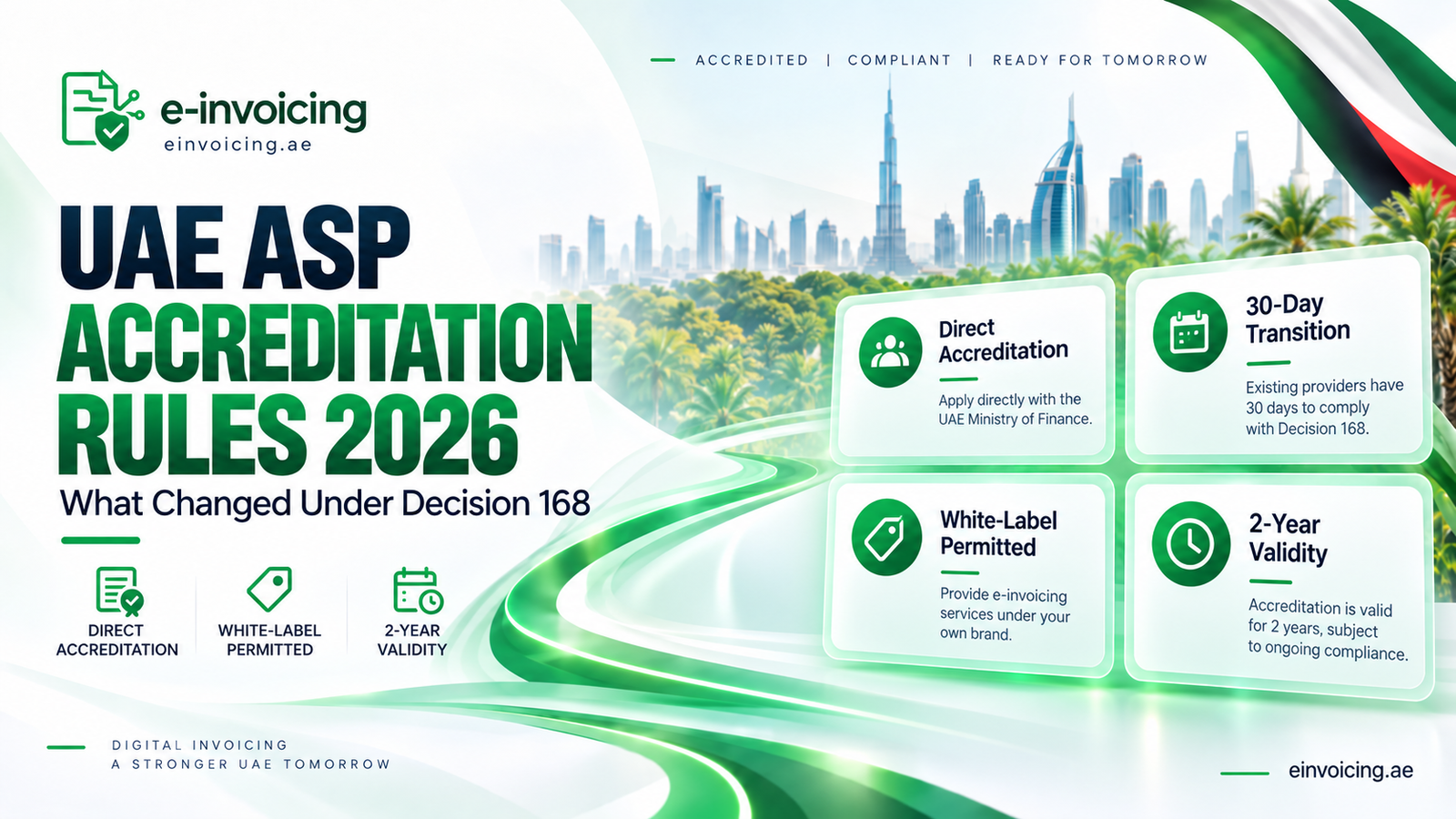
New applicants no longer pass through the former preliminary approval stage. Instead, the MoF assesses eligibility and the provider must complete the prescribed technical tests before accreditation is granted.
For businesses, this makes verifying actual accreditation status essential. A provider’s technical demonstration or statement that approval is expected should not be confused with accreditation.
Existing Pre-Approved Providers Receive Transitional Treatment
Article 19 gives providers already pre-approved under Decision 64 up to 30 days from 1 October 2026 to satisfy the new accreditation requirements. They ordinarily do not need to submit another application unless the MoF determines otherwise and provides reasons.
If a provider does not meet the requirements within the prescribed period, its preliminary approval will be terminated. During this transition, businesses should distinguish a pre-approved listing from a fully accredited provider.
White-Label Technology and Outsourcing Remain Permitted
Article 4 allows applicants to use a third-party Peppol Service Provider Product (PSP Product) and outsource its development, operation, management or elements of the service.
The applicant must still be an active Peppol-certified service provider satisfying the applicable criteria. Its responsibility for regulatory compliance, service delivery and oversight cannot be transferred to the technology partner.
The experience condition may be met where the PSP Product has operated for at least two years and the applicant or relevant third party has experience operating or managing it, supported by evidence required by the MoF. A white-label agreement alone is insufficient.
Accreditation Is Subject to Continuing Oversight
Accreditation lasts two years. Article 15 requires renewal applications no later than 70 business days before expiry, supported by evidence of continuing eligibility and insurance. The Ministry can request compliance information and may terminate accreditation in the circumstances specified in the decision.
What Must a UAE ASP Demonstrate?
Peppol, Company and Financial Eligibility
Article 4 requires an active Peppol-certified service provider that has completed OpenPeppol conformance tests. The applicant must also satisfy UAE company licensing conditions, maintain at least AED 50,000 paid-up capital, and meet Corporate Tax and VAT registration obligations where applicable.
Article 5 requires audited financial statements for the most recent financial year where available. If unavailable at application, they must be submitted within six months following the end of that financial year.
Information Security and Business Continuity
Article 8 requires the PSP Product to use multifactor authentication, encryption in transit and at rest, regular security monitoring, and valid ISO/IEC 27001 certification. These requirements concern the technology product, alongside applicable hosting and data-residency requirements.
Separately, Article 5 requires ISO 22301 business-continuity certification for the provider. If unavailable when applying, the decision provides for submission within three months following the end of the most recent financial year. This is not a general three-month extension measured from accreditation.
Insurance and 100 Free Services Per End User
Article 10 specifies professional indemnity insurance of at least AED 2.5 million, plus AED 5 million each in crime insurance and cyber-fraud insurance, with insurers operating in the UAE.
A significant provision for customers appears in Article 9(4): ASPs must commit to 100 free eInvoice exchange and reporting services annually for each end user, commencing from the signing of that end user’s agreement. Businesses should ask providers to explain how this statutory commitment is reflected in commercial proposals; it does not automatically make every other software or support service free.
Article 4 allows the Minister to waive a condition under that article, but applicants should not assume any waiver without formal confirmation.
How Does the New ASP Accreditation Process Work?
Applicants submit evidence and the prescribed forms through the MoF eInvoicing Service Provider Accreditation service.
Under Article 11, the MoF must issue an initial decision or request further information within 90 business days of receiving the application. If further information is requested, it must decide within 30 business days of receiving that information. These are application-review periods, not a guarantee that accreditation and testing will finish within 90 days.
Following approval of the application, Article 12 requires interoperability and end-user verification testing, followed by prescribed tax-data reporting, Peppol service and production-readiness procedures. Final accreditation and publication follow satisfactory completion under Article 13.
What Does Decision 168 Mean for UAE Businesses?
Verify Accreditation Before Appointment
Check the legal entity in the MoF accredited ASP directory against the contracting provider. Confirm its current status rather than relying solely on marketing material or third-party accreditation claims.
Review Contracts, Free Services and Continuity
Clarify service ownership, subcontracting, security responsibilities, incident escalation, data access and options if the ASP loses accreditation. Ask how the 100-free-services commitment works under the agreement. These are practical contract checks, not additional accreditation conditions.
Continue ERP and Invoice Testing
MoF accreditation does not prove that a provider integrates with every accounting platform. Verify document mapping, exchange, tax-data reporting and support for failed invoices. Our ERP preparation guide and invoice validation-errors guide provide practical testing steps. For a wider overview, see how to comply with UAE e-invoicing.
Does Decision 168 Change the UAE E-Invoicing Deadlines?
No. It regulates ASP accreditation rather than business implementation. Under Decision 244 of 2025 as amended by Decision 66 of 2026, in-scope businesses with annual revenue equal to or above AED 50 million must appoint an ASP by 30 October 2026 and implement e-invoicing by 1 January 2027. For in-scope businesses below AED 50 million, the corresponding dates are 31 March 2027 and 1 July 2027.
Our ASP deadline update explains the first-phase extension.
What Should Businesses Do Now?
Confirm which implementation phase applies, verify the provider’s accreditation, compare contract terms and test the full invoice workflow before go-live. For ASP applicants, prioritise evidence of Peppol certification, experience, security, capital, financial statements and prescribed testing.
Businesses seeking independent preparation support can start with the einvoicing.ae readiness assessment.
Decision 168 changes how providers obtain and retain accreditation; businesses still need a properly accredited provider and a tested invoicing process.