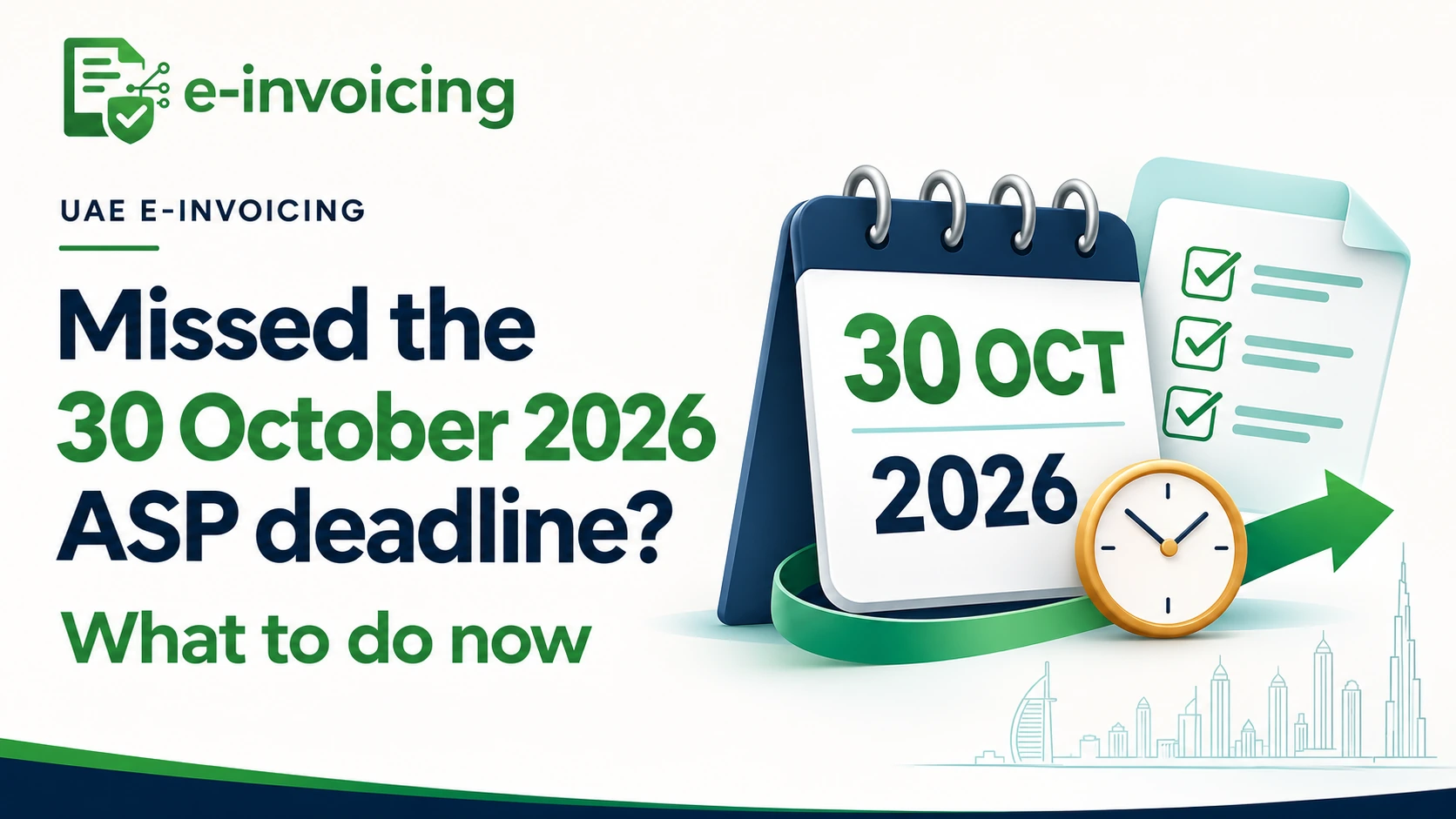
The 30 October 2026 deadline for appointing an Accredited Service Provider (ASP) has passed for persons subject to UAE e-invoicing with annual revenue of AED 50 million or more. Their mandatory implementation date remains 1 January 2027.
If your business falls within this category and has not completed its ASP appointment, start by confirming what remains outstanding. Resolve the appointment and onboarding requirements promptly, while progressing ERP preparation, invoice-data checks and testing.
If you appointed an ASP on time, your priority is different: confirm that the remaining implementation work is on schedule. Appointing a provider does not, by itself, mean your business is ready to operate the e-invoicing system.
Quick Summary
- Affected category: Persons subject to UAE e-invoicing with annual revenue of AED 50 million or more.
- ASP appointment deadline: 30 October 2026, now passed.
- Mandatory implementation: 1 January 2027.
- If appointment is incomplete: Confirm the outstanding contractual and onboarding requirements and address them promptly.
- If an ASP is already appointed: Focus on integration, data readiness, testing and operational responsibilities.
- For later implementation phases: Check your own applicable dates before assuming your business has missed a deadline.
Why Was the ASP Deadline Extended to 30 October 2026?
The ASP appointment deadline for the first mandatory implementation phase was extended from 31 July to 30 October 2026 through Ministerial Decision No. 66 of 2026. The extension gave affected businesses additional time to select and appoint a provider.
It did not change the 1 January 2027 implementation date. With the appointment deadline now past, businesses should address any outstanding appointment requirements and complete the work needed for implementation.
Which UAE E-Invoicing Deadlines Apply to Your Business?
The ASP appointment deadline and mandatory implementation date are separate milestones. The phased timetable is:
| Category | ASP appointment deadline | Mandatory implementation date |
|---|---|---|
| Persons in scope with annual revenue of AED 50 million or more | 30 October 2026 | 1 January 2027 |
| Persons in scope with annual revenue below AED 50 million | 31 March 2027 | 1 July 2027 |
| Government entities | 31 March 2027 | 1 October 2027 |
Check both your scope and revenue category before concluding that you missed the October deadline. For this timetable, revenue means gross income for the most recent accounting period, supported by the relevant financial statements or, where these are unavailable, other documentation acceptable to the FTA. The revenue threshold alone does not determine whether every business or transaction is within scope.
What Does an Accredited Service Provider Do?
An Accredited Service Provider is approved to provide UAE electronic invoicing services. It supports the exchange of structured invoices and the reporting of required tax data within the UAE framework. Your business and provider must agree how invoice data will move between your accounting or ERP system and the e-invoicing service.
The Ministry of Finance’s October 2026 guidelines explain that the taxpayer initiates onboarding through EmaraTax. Contractual and commercial requirements with the selected ASP should be completed before onboarding to its system through EmaraTax. A quotation or an initial discussion with a provider should therefore not be treated as evidence that the required appointment and onboarding steps are complete.
First, Confirm Your ASP Appointment Status
Before deciding what to do next, establish which situation applies to your business.
| Your situation | Immediate priority |
|---|---|
| No ASP has been selected | Confirm your obligations and assess suitable providers promptly. |
| A provider has been selected, but requirements remain outstanding | Identify unfinished contractual, commercial or onboarding steps and agree who will resolve them. |
| Appointment is complete, but implementation is behind | Confirm integration blockers, testing dates and responsibilities with your ASP and ERP team. |
| Your appointment status or applicable deadline is unclear | Review the supporting records and seek clarification from the provider, FTA or a registered tax agent, as appropriate. |
Keep a dated record of the position. Distinguish completed actions from pending actions rather than describing the whole project as “in progress”.
What to Do Now If You Missed the ASP Deadline
The following actions are practical project recommendations. They do not extend a statutory deadline or create a grace period.
1. Confirm the affected entity and outstanding obligations
Ask the finance or tax lead to document which entity is affected, its applicable implementation phase and the outstanding appointment requirements. Collect relevant revenue records, provider correspondence and any completed agreements.
2. Resolve the provider appointment and onboarding requirements
If no provider has been selected, check the Ministry of Finance’s published ASP information and assess providers against your systems, invoice volumes and support needs. If a provider is already selected, obtain a clear list of unfinished requirements and assign an owner to each.
Consider ERP compatibility, integration support, service levels, data access and total costs when making the decision.
3. Identify ERP and invoice-data blockers
Have finance and IT review representative invoices and credit notes together. Record missing data, inconsistent customer records, tax-code issues and any limitations in the current invoice export.
Agree which changes belong to your ERP team, which belong to the ASP and which require business input. Do not assume that a general software update will resolve every gap.
4. Agree a dated implementation plan
Bring the ASP, ERP team and internal project owner into one working plan. Include configuration, data mapping, testing, staff preparation and go-live responsibilities.
Give each unresolved item an owner and completion date. Escalate dependencies that threaten the applicable implementation deadline instead of leaving them in separate email threads.
5. Test the complete invoice process
Agree test cases covering the transactions your business actually handles. Check invoice exchange and reporting, incoming invoices, credit notes and the handling of unsuccessful submissions.
Record results and retest corrected issues. A successful demonstration using one standard invoice is not sufficient evidence that all your business scenarios are ready.
6. Maintain a clear evidence file
Keep agreements, onboarding confirmations, support references, test results and unresolved issues together. Use accurate dates and distinguish provider confirmations from internal assumptions.
If an appointment or compliance issue remains unresolved, seek clarification through the appropriate official channel and retain the response.
Can Missing the ASP Appointment Deadline Lead to Penalties?
Cabinet Decision No. 173 of 2026 replaces the earlier e-invoicing penalty decision. Its implementation-failure category expressly includes failure to appoint an Accredited Service Provider.
For this category, the decision provides for AED 5,000 for the first violation, followed by AED 5,000 for each month or part of a month during which non-compliance continues. The aggregate ceiling for this category is AED 50,000 within any twelve consecutive months. This is not a blanket ceiling covering every type of e-invoicing violation.
Completing outstanding appointment steps does not automatically establish that an earlier breach has been waived. If your business missed its applicable deadline or receives a penalty notice, ask the FTA or a registered tax agent to assess the relevant obligation, dates and circumstances.
Common Mistakes After the ASP Deadline
Avoid these assumptions:
- A quotation or verbal agreement proves the appointment is complete.
- Appointing an ASP means the ERP and invoice data are ready.
- Completing the appointment late automatically removes any penalty exposure.
- Provider delays automatically extend your statutory deadline.
- Testing can be skipped to recover lost time.
- The October appointment deadline applied to every UAE business.
The practical priority is to establish the facts, close outstanding requirements and keep implementation moving with clear ownership.
How eInvoicing.ae Can Help
If your ASP appointment is incomplete or your implementation is behind schedule, eInvoicing.ae can help you identify the outstanding work and organise the next steps.
Our support covers readiness assessment, ASP coordination, ERP and invoice-data reviews, and implementation planning for finance and IT teams.
A UAE e-invoicing readiness assessment can help establish your gaps and priorities. If you already have a provider and need help progressing the project, explore our e-invoicing implementation support.