

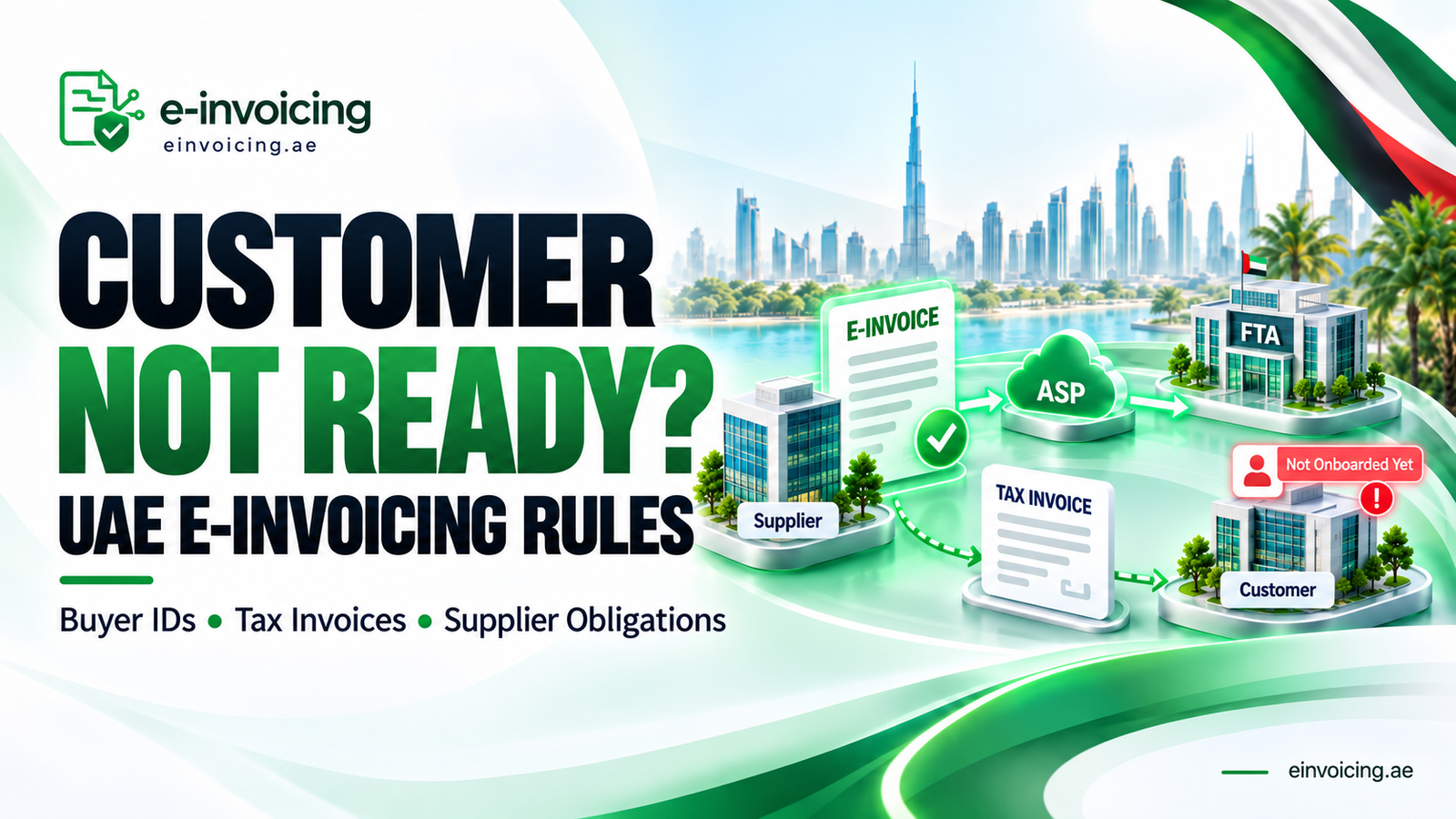
What happens when your customer is not ready for UAE e-invoicing, but your business must already comply? You must continue meeting your own electronic invoicing obligations for in-scope transactions, even if your customer has not joined the system.
Under the Ministry of Finance (MoF) Electronic Invoicing Guidelines V1.1, suppliers may need to issue both a structured electronic Tax Invoice and a conventional Tax Invoice. Where the customer has no Peppol Participant Identifier, a prescribed electronic address must also be used.
However, if your business has not reached its mandatory implementation date and has not voluntarily implemented e-invoicing, the existing applicable VAT invoicing rules continue to apply.
This guide explains the rules for a UAE e-invoicing buyer not onboarded, how to identify customers correctly, which documents to issue, and how to prepare your finance and ERP systems.
Does Your Customer Need to Be Ready Before You Issue E-Invoices?
No. Your customer’s e-invoicing status does not determine when your business must comply.
Section 6.1 of the MoF Electronic Invoicing Guidelines V1.1 confirms that a customer’s onboarding or tax-registration status does not affect a supplier’s electronic invoicing obligations for an in-scope Business Transaction.
Three situations should be distinguished:
- Supplier already subject to mandatory e-invoicing: Must issue the required electronic documents, even if the customer is not onboarded.
- Supplier voluntarily implementing e-invoicing: Must follow the applicable technical requirements from voluntary implementation.
- Supplier not yet required and not voluntarily implemented: Continues complying with existing invoicing requirements while preparing for its implementation phase.
For broader applicability, see our UAE e-invoicing scope and exclusions guide.
Must Suppliers Issue Both Electronic and Regular Tax Invoices?
Yes, when the supplier is issuing electronic Tax Invoices to customers who have not implemented UAE e-invoicing.
Section 10.2.2 of the MoF Guidelines expressly requires regular Tax Invoices, such as PDFs, in addition to electronic Tax Invoices in this situation.
Structured Electronic Tax Invoice
A UAE electronic Tax Invoice is created in a structured format through the supplier’s Accredited Service Provider (ASP), following the applicable UAE electronic invoicing requirements.
It supports the prescribed electronic processing and tax-data reporting to the Federal Tax Authority (FTA).
A PDF sent by email is not, by itself, a structured electronic Tax Invoice.
Conventional Tax Invoice
The supplier must also provide the non-onboarded buyer with a regular Tax Invoice that complies with UAE VAT requirements.
This allows the customer to review transaction details, process payment and retain supporting documents for input VAT recovery, where eligible.
Important: Both documents represent the same underlying sale. Businesses should reconcile the references, taxable amounts and VAT values to prevent duplicate accounting entries.
Once the buyer implements e-invoicing, a separate conventional Tax Invoice may no longer be required if the electronic Tax Invoice meets Article 65 of the VAT Decree-Law and Article 59 of the VAT Executive Regulation.
What About Electronic Commercial Invoices?
Not every UAE business transaction requires a VAT Tax Invoice.
Section 10.2.1 of the MoF Guidelines explains that Commercial Invoices may cover exempt or out-of-scope supplies, or supplies made by businesses not registered for VAT.
For in-scope transactions, traditional Commercial Invoices must be replaced by compliant structured electronic Commercial Invoices.
Where the buyer has not onboarded, a readable commercial document may also be needed for accounting or payment purposes.
However, the explicit statutory requirement to issue both conventional and electronic Tax Invoices should not automatically be applied identically to every Commercial Invoice.
Which UAE Peppol Buyer Identifier Should Suppliers Use?
Correct buyer identification is essential for invoice validation and routing.
When the Buyer Is Already Onboarded
A UAE participant uses a Peppol Participant Identifier based on its Tax Identification Number (TIN), using scheme identifier 0235.
Suppliers should verify the buyer’s registered electronic address and confirm that their ASP can process invoices for that participant.
When the Buyer Is Not Onboarded
Where the buyer has not implemented e-invoicing and does not have a Participant Identifier, Section 10.2.2 prescribes this predefined endpoint:
0235:9900000098
The identifier contains:
- 0235: UAE participant identification scheme.
- 9900000098: Predefined recipient identification value.
The 9900000098 endpoint is not the customer’s actual TIN or TRN.
It is a technical identifier used for the prescribed situation. Suppliers must retain the customer’s real tax and legal-entity details separately in their master data.
The UAE Peppol PINT AE specifications describe this as a predefined-endpoint scenario.
The supplier should configure the endpoint through its ASP rather than inserting it automatically whenever customer information is missing.
Is a Buyer Without a TRN Automatically Not Onboarded?
No. A Tax Registration Number (TRN), TIN and Peppol Participant Identifier serve different purposes.
A buyer may have a valid VAT TRN but not yet have an active e-invoicing Participant Identifier. Conversely, an in-scope business not registered for VAT may still require a TIN.
Our UAE e-invoice mandatory fields guide explains the identification information businesses should capture.
UAE E-Invoicing Buyer Readiness: Which Invoice Should You Issue?
The following table helps finance teams determine the correct initial action.
Supplier and customer situation | Electronic invoice | Regular Tax Invoice | Required action |
Supplier not yet required and not voluntarily implemented | Not yet required by the phased mandate | Issue where required by VAT law | Prepare for supplier’s implementation phase |
Supplier required; buyer already onboarded | Required for in-scope transactions | Generally not separately required if the electronic Tax Invoice meets VAT requirements | Use verified buyer Participant Identifier |
Supplier required; buyer not onboarded | Required for in-scope transactions | Required where a Tax Invoice must be issued | Use predefined endpoint if buyer has no Participant Identifier |
Supplier required; buyer has TRN but no Participant Identifier | Required for in-scope transactions | Required while buyer has not implemented | Verify status and endpoint handling with ASP |
Supplier sells to an individual purchasing as a consumer | Generally excluded from the current B2C mandate | Apply normal VAT invoicing rules | Confirm consumer classification |
The table describes Tax Invoice situations. Commercial Invoices and special transactions require their applicable document rules.
Practical Example: Large Supplier Selling to a Smaller UAE Business
Consider the following example.
Supplier A: A UAE business with annual revenue above AED 50 million, required to implement e-invoicing from 1 January 2027.
Customer B: A smaller UAE business whose mandatory implementation date is 1 July 2027. It has not voluntarily implemented e-invoicing and has no Participant Identifier.
In February 2027, Supplier A sells taxable goods to Customer B.
Supplier A should:
- Generate the structured electronic Tax Invoice through its ASP.
- Apply the prescribed 0235:9900000098 endpoint because Customer B has no Participant Identifier.
- Provide Customer B with a regular VAT-compliant Tax Invoice.
- Verify that the required FTA tax-data reporting response is received.
- Match the electronic and conventional documents to the same sale without creating duplicate revenue or VAT entries.
The customer’s later implementation deadline does not postpone Supplier A’s obligations.
This is a practical example of why customer onboarding must be tracked separately from supplier implementation.
How Does Reporting Work When the Buyer Is Not Onboarded?
Under the normal UAE model, structured invoices are exchanged through the supplier’s and buyer’s ASPs, with relevant tax data reported to the FTA.
However, the Peppol specifications provide a reporting-only arrangement for the prescribed predefined-endpoint scenarios.
Where this arrangement applies, the document does not need to be exchanged through the buyer’s ASP. The supplier’s ASP performs the required reporting process.
The supplier must still provide the conventional Tax Invoice where Section 10.2.2 requires it.
What Should the Supplier Monitor?
Finance teams should verify that:
- the correct buyer endpoint was selected;
- the electronic document passed applicable validation;
- the required FTA reporting confirmation was received;
- the regular Tax Invoice reached the customer; and
- the accounting records contain only one underlying sale.
In a reporting-only scenario, the absence of a normal buyer-ASP exchange response is not necessarily an error.
Suppliers should confirm the expected statuses with their ASP before classifying a transaction as failed.
What Happens If the Customer Uses Self-Billing?
Self-billing requires special attention when the buyer is not yet onboarded.
Section 10.3 of the MoF Guidelines states that the buyer must be on the Electronic Invoicing System to issue a self-billed electronic Tax Invoice.
For a valid self-billing arrangement:
- the supplier must be VAT-registered;
- the arrangement must satisfy applicable UAE VAT requirements;
- an appropriate agreement must exist between the supplier and buyer; and
- the buyer must be capable of issuing the structured self-billed electronic Tax Invoice.
The UAE framework does not provide for self-billed electronic Commercial Invoices.
If a supplier’s implementation date arrives before its self-billing customer is ready, the parties should review the arrangement and establish a compliant alternative invoicing process.
UAE E-Invoicing Implementation Deadlines
Under Ministerial Decision No. 244 of 2025, as amended by Decision No. 66 of 2026, the main phases are:
In-scope business | ASP appointment deadline | Mandatory implementation |
Revenue of AED 50 million or more | 30 October 2026 | 1 January 2027 |
Revenue below AED 50 million | 31 March 2027 | 1 July 2027 |
Businesses should confirm their applicable phase independently of their customers’ implementation dates.
How Should Finance and ERP Teams Prepare?
A customer-readiness process should be established before mandatory go-live.
Verify Customer Master Data
Record the customer’s legal entity, VAT status, TIN, TRN, Participant Identifier and current onboarding status.
Configure the Appropriate Invoice Workflow
Distinguish onboarded customers from buyers requiring the predefined endpoint and conventional Tax Invoice delivery.
Review our ERP preparation guide for data mapping and integration requirements.
Test Validation and Reporting
Test normal electronic invoice exchange, reporting-only scenarios, missing buyer identifiers, failed validation and recovery procedures.
Our UAE e-invoice validation-errors guide explains common errors and how to resolve them.
Maintain a Customer Readiness Register
Finance teams should maintain a register showing:
- customer name and legal entity;
- VAT registration and Participant Identifier status;
- relevant endpoint and invoice-delivery method;
- responsible employee; and
- date of the latest verification.
Update customer records as buyers complete onboarding, and establish a process for switching them from reporting-only handling to normal electronic exchange where applicable.
Key Takeaways for UAE Suppliers
A customer’s lack of e-invoicing readiness does not remove the supplier’s own obligations once the supplier is required to comply or has voluntarily implemented the system.
For Tax Invoices issued to customers who have not implemented electronic invoicing, the MoF requires both structured electronic and conventional Tax Invoices.
Where the buyer has no Participant Identifier, the prescribed 0235:9900000098 endpoint applies in the relevant scenario. This is a technical endpoint, not the customer’s TIN or TRN.
Businesses should prepare customer master data, test ASP reporting, monitor customer onboarding and prevent duplicate accounting entries.
For assistance with buyer identification, ERP integration and implementation readiness, visit the einvoicing.ae readiness assessment.