
UAE E-Invoicing Guidelines V1.1: New Rules for Invoice Storage, Advance Payments and Retention
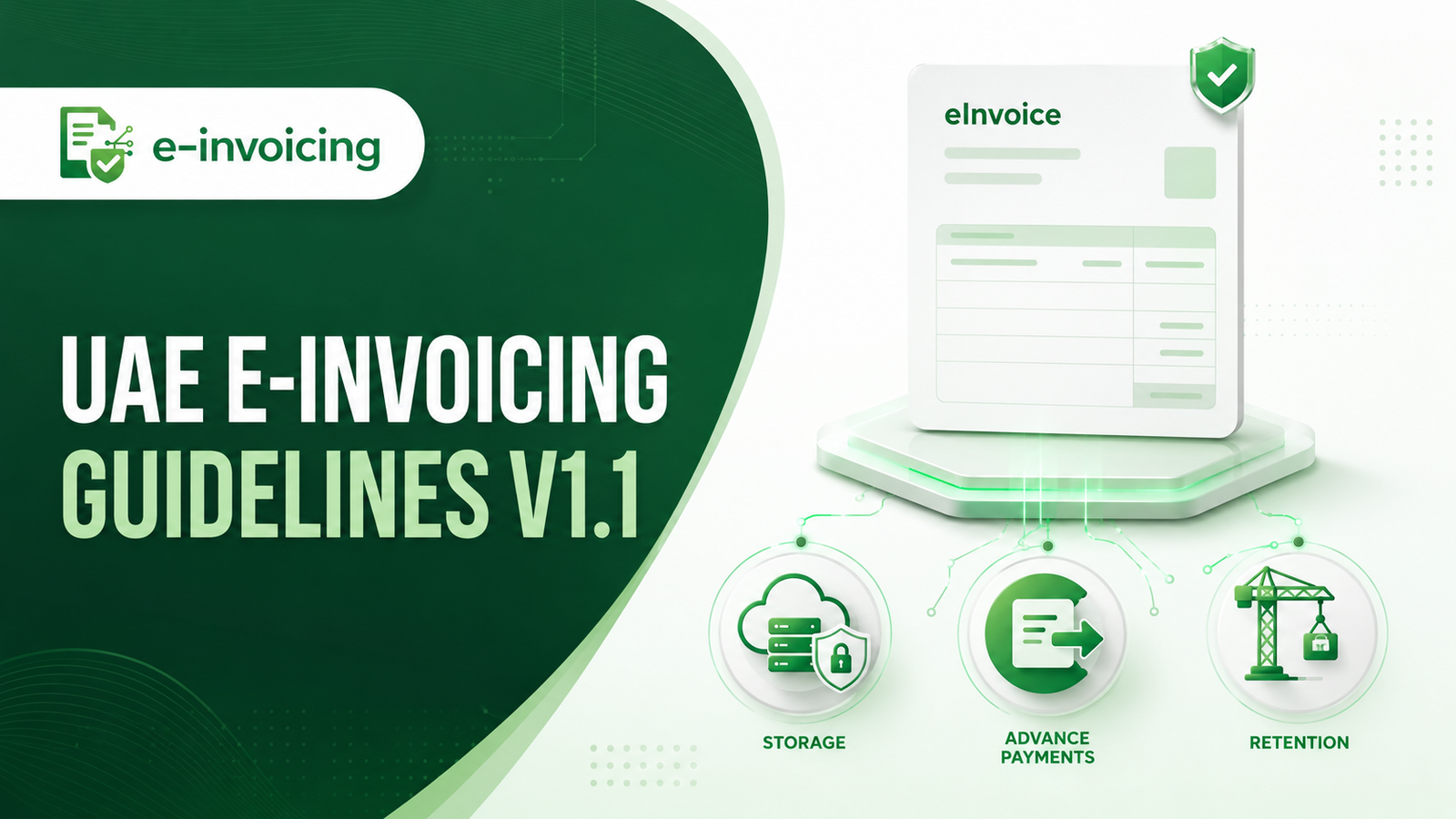
The UAE Ministry of Finance issued Version 1.1 of the UAE Electronic Invoicing Guidelines on 1 June 2026. It provides practical guidance on electronic invoice storage, advance payments and contractual retention.
Version 1.1 does not replace the e-invoicing framework or change its main implementation deadlines. It clarifies how businesses and Accredited Service Providers (ASPs) should apply existing requirements in practice.
Here is what UAE finance, tax and technology teams need to know.
What changed in UAE E-Invoicing Guidelines V1.1?
The updated guidelines add two important sections:
- Appendix 4 provides further guidance on the storage obligations established under Article 11 of Ministerial Decision No. 243 of 2025.
- Appendix 5 explains the e-invoicing treatment of advance payments and retention amounts for PINT AE purposes.
The core framework remains unchanged. A UAE e-invoice is structured data exchanged between supplier and buyer through accredited service providers, with relevant tax data reported to the Federal Tax Authority (FTA). A PDF, scan, image, Word file or invoice sent only by email is not a compliant e-invoice.
Clarification of UAE e-invoicing storage requirements
Electronic invoices, credit notes and associated data must be retained under applicable UAE tax legislation. Records must remain secure, accessible, retrievable and reproducible for the FTA.
Storage is not restricted to a particular layer of the five-corner model. Records may be maintained in the business’s ERP, accounting system, document archive, another suitable system or an agreed ASP storage service. The arrangement must protect their integrity and availability throughout the applicable retention period.
Records can be hosted outside the UAE if they remain securely accessible, reproducible and available to the FTA when requested. Other applicable legal, contractual, confidentiality and data-protection requirements must still be considered.
Delegating storage does not delegate responsibility
A business may agree contractually for its ASP to store electronic invoices, credit notes and associated data. However, outsourcing this function does not transfer the business’s legal record-keeping responsibility.
The business should therefore understand:
- which documents and data the ASP will retain;
- the applicable retention period;
- how quickly records can be retrieved;
- the export format available if the ASP contract ends;
- backup, security and business-continuity arrangements; and
- the process for supplying records during an FTA review or audit.
ASP transaction logs are not automatically a complete invoice archive. Logs may demonstrate routing, validation and delivery, but the business must ensure the underlying electronic invoices, credit notes and associated data are retained.
How should advance payments be handled?
Advance payments are common in construction, property, professional services and long-term contracts. Receiving an advance can create a VAT tax point, and Version 1.1 clarifies how the related invoices should be represented.
When a business receives an advance payment and VAT becomes due, it must issue the appropriate tax invoice at the time of receipt. When the final invoice is issued, it should cover the remaining amount rather than invoicing the full contract value again, because a tax invoice has already been issued for the advance.
The final invoice should reference the earlier advance invoice through the relevant PINT AE fields. This creates traceability and helps prevent duplicate taxation, reporting or collection.
Businesses should confirm that their ERP or billing system can:
- create an invoice when an advance is received;
- allocate the payment to the correct contract or order;
- retain the original invoice number and date;
- reference the advance invoice in the final structured invoice;
- calculate VAT and the remaining balance correctly; and
- pass the required structured information to the ASP.
A system that only deducts a deposit on a PDF may not provide the required structured references.
Retention amounts under UAE e-invoicing
Retention is common in construction and project contracts, where a customer withholds part of an amount until a contractual condition is satisfied.
Version 1.1 states that businesses may continue their existing commercial and accounting practices for retention, provided those practices comply with applicable VAT and electronic invoicing requirements. The guidelines include a structured invoicing approach under which the business invoices the amount excluding retention first and issues a separate invoice for the retained amount when it becomes payable.
Not every retention contract should be processed identically. VAT treatment can depend on the contract, supply date, payment terms, certification and when retention becomes due. Review these points before configuring automated rules.
The ERP should distinguish contractual retention from an unpaid balance and preserve links between the contract, initial invoice, certification and later retention invoice.
What Version 1.1 means for ASP and ERP selection
An e-invoicing solution must support more than standard invoices. It should also handle transactions that commonly create compliance and reconciliation problems.
When reviewing an ERP configuration or selecting an accredited service provider, businesses should test whether the proposed process can:
- store and retrieve the complete structured invoice record;
- preserve invoice integrity and an audit trail;
- communicate transmission and validation statuses without undue delay;
- link advance invoices with final invoices;
- process retention billing correctly;
- handle electronic credit notes and corrections; and
- export records if the company changes systems or service providers.
Responsibilities should be documented between the business, ERP vendor, consultant and ASP. An ASP can validate and transmit data, but it cannot correct weak master data, tax logic or internal processes.
Actions UAE businesses should take now
Finance and technology teams should review real transaction scenarios, not only ordinary sales invoices. Key actions include:
- Identify every process involving deposits, prepayments and contractual retention.
- Confirm when VAT becomes due and which document must be issued.
- Map the required invoice references and amounts into the PINT AE structure.
- Review where electronic invoices and associated data will be stored.
- Confirm retrieval, security, backup and system-exit arrangements with the ASP.
- Test advance-payment and retention scenarios before production use.
- Update accounting procedures, approval controls and staff training.
Businesses should also review their broader ERP readiness for UAE e-invoicing and verify that their systems capture the applicable UAE e-invoice mandatory fields.
Prepare for operational compliance
Version 1.1 moves e-invoicing from awareness to practical implementation. Storage must support retrieval and audit access, advance invoices must connect with final billing, and retention must reflect the contract, VAT treatment and structured-invoice requirements.
Businesses that examine these processes early will be better positioned to avoid invoice rejection, duplicate reporting, reconciliation differences and missing audit records. A detailed readiness assessment can identify gaps across invoice data, ERP configuration, tax logic, ASP integration and record retention before implementation.
For authoritative requirements, businesses should consult the UAE Ministry of Finance e-invoicing portal and the UAE Electronic Invoicing Guidelines Version 1.1.
Need support preparing your systems and processes? Request a UAE e-invoicing readiness assessment to identify data, ERP, tax and ASP integration gaps before go-live.