UAE e-invoicing penalties apply when businesses subject to mandatory electronic invoicing fail to meet their implementation, invoice-transmission or data-update obligations. The UAE is moving from conventional invoicing to structured electronic invoices exchanged through Accredited Service Providers (ASPs), with relevant tax data reported to the Federal Tax Authority (FTA).
On 30 October 2026, the Ministry of Finance (MoF) announced Cabinet Decision No. 173 of 2026, which replaces Cabinet Decision No. 106 of 2025. The revised framework introduces a clear limit for implementation failures, reduces the penalty for late updates to your ASP and removes the previous system-failure notification fine.
This guide explains the current UAE e-invoicing fines, who can be penalised, the applicable limits and practical steps businesses can take to reduce compliance risk.
What Are the UAE E-Invoicing Penalties?
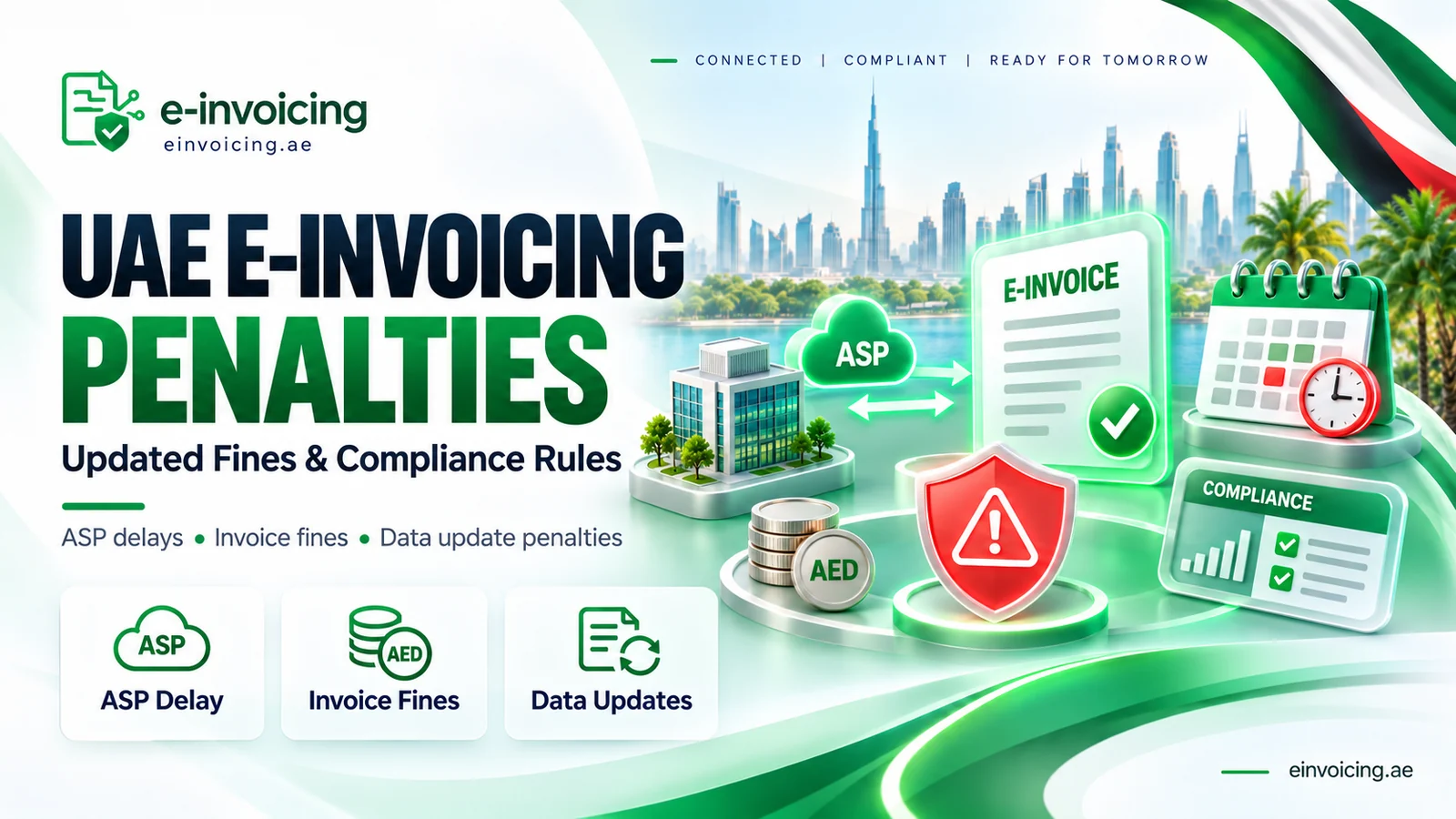
Under Cabinet Decision No. 173 of 2026, the main penalties are AED 5,000 for an initial implementation violation (followed by monthly penalties while it continues), AED 100 for each electronic invoice or credit note that is not issued and transmitted, and AED 250 per day for late notification to your ASP of changes to FTA-registered data.
The table below summarises the official penalty schedule.
Violation
Administrative penalty
Failure by an Issuer or Recipient to implement e-invoicing, including failure to appoint an ASP, or a Recipient's later failure to maintain compliance
AED 5,000 initially, then AED 5,000 for each month or part of a month of continued non-compliance. Maximum AED 50,000 within any 12 consecutive months for these violations
Failure by an Issuer to issue and transmit an Electronic Invoice to the Recipient through the system
AED 100 per Electronic Invoice, capped at AED 5,000 per calendar month
Failure by an Issuer to issue and transmit an Electronic Credit Note to the Recipient through the system
AED 100 per Electronic Credit Note, capped at AED 5,000 per calendar month
Failure by an Issuer or Recipient to notify its appointed ASP of changes to data registered with the FTA
AED 250 per day or part of a day of delay, capped at AED 5,000 per calendar month
Source: Cabinet Decision No. 173 of 2026, annexed penalty schedule.
Important: The AED 50,000 limit applies only to the implementation-related violations in the first row. It is not an overall cap on all e-invoicing penalties.
Who Can Be Penalised for E-Invoicing Non-Compliance?
The framework applies to persons required to comply with UAE electronic invoicing legislation, including relevant businesses that are not registered for VAT.
Cabinet Decision No. 173 of 2026 uses two important roles:
- Issuer: a person required to issue, transmit, share and exchange Electronic Invoices and Electronic Credit Notes through the system.
- Recipient: a person required to receive Electronic Invoices and Electronic Credit Notes through the system.
A business may act in both roles.
Article 2 excludes persons who issue, transmit, share, exchange or report electronic invoices and credit notes on a voluntary basis from this penalty regime while their participation remains voluntary. Existing VAT and tax-procedure obligations continue to apply.
Article 3 also prevents duplicate penalties: where the same person acts as an Issuer, a Recipient or both for the same violation, only one penalty applies. Separate violations can still attract their own penalties.
What Is the Penalty for Missing the ASP Appointment Deadline?
Failure to appoint an Accredited Service Provider by the prescribed deadline falls under the implementation-violation category.
The penalty is AED 5,000 initially, followed by AED 5,000 for each month or part of a month during which non-compliance continues, subject to the AED 50,000 limit within any 12 consecutive months.
The main implementation phases are:
In-scope business
ASP appointment deadline
Mandatory implementation
Annual revenue of AED 50 million or more
30 October 2026
1 January 2027
Annual revenue below AED 50 million
31 March 2027
1 July 2027
Businesses should check the relevant legal entity, revenue threshold and transaction scope before deciding which deadline applies. Phase dates follow Ministerial Resolution No. 66 of 2026.
Our UAE E-Invoicing Guidelines V2.0 article explains the broader implementation requirements, and our timeline and scope guide covers each phase in detail.
What Are the Fines for Missing E-Invoices and Credit Notes?
The FTA e-invoicing penalties framework treats implementation failures separately from failures to issue and transmit individual documents.
Under the revised schedule, AED 100 applies for each required Electronic Invoice or Electronic Credit Note that an Issuer fails to issue and transmit through the Electronic Invoicing System, subject to a cap of AED 5,000 per calendar month for each category.
- 12 invoices not issued and transmitted in a month: 12 × AED 100 = AED 1,200
- 70 invoices not issued and transmitted in a month: 70 × AED 100 = AED 7,000, reduced to the monthly cap of AED 5,000
These are illustrative calculations, assuming the relevant obligations and penalty provisions apply. Credit notes are calculated separately with their own AED 5,000 monthly cap.
Businesses should also distinguish e-invoicing deadlines from VAT-law invoicing deadlines. Our invoice deadline guide explains the 14-business-day and 14-calendar-day requirements.
Is There Still a Fine for Not Reporting a System Failure?
No. The previous administrative penalty for failing to notify the FTA of a system failure has been removed from the revised e-invoicing penalty framework.
Ministerial Decision No. 197 of 2026, effective 1 October 2026, repealed Article 12 of Ministerial Decision No. 243 of 2025, which previously required notification of a system failure within two business days. Cabinet Decision No. 173 of 2026 also removed the related administrative penalty.
Businesses should still maintain effective incident-response procedures, monitor failed transmissions, retain transaction records and coordinate recovery with their ASP. Other legal or contractual requirements may still apply.
The Ministry of Finance announcement explains the regulatory changes.
How Can UAE Businesses Avoid E-Invoicing Penalties?
Reducing exposure to e-invoicing fines in the UAE requires reliable processes, not just compliant software.
Businesses should put the following controls in place:
- Confirm compliance obligations: identify the applicable implementation phase, transaction scope and ASP appointment deadline.
- Monitor invoice transmission: reconcile ERP invoices against ASP exchange and reporting statuses, and investigate unresolved transactions.
- Resolve validation errors: assign responsibility for rejected invoices, credit notes and controlled retransmissions. See our e-invoice validation errors guide.
- Maintain registered information: notify your appointed ASP of changes to FTA-registered data promptly and keep evidence of each notification.
- Test systems regularly: review invoice mapping, integration, user permissions, exception handling and record retrieval.
These are recommended controls. The legislation determines which failures are penalised violations. Our how to comply guide provides further implementation guidance.
Key Takeaways for UAE Businesses
UAE e-invoicing penalties now include a clear limit for implementation failures, alongside separate penalties for missing electronic invoices, missing credit notes and late notification of registered-data changes.
Businesses should distinguish between missing the ASP appointment deadline, failing to implement the system and failing to issue and transmit individual documents.
Cabinet Decision No. 173 of 2026 takes effect from the day after its publication in the Official Gazette, so check the Gazette date before applying it to a specific period. These administrative penalties are also separate from penalties under UAE VAT and tax-procedures legislation.
For help assessing your implementation risks, ASP integration and invoice controls, request an e-invoicing readiness assessment.