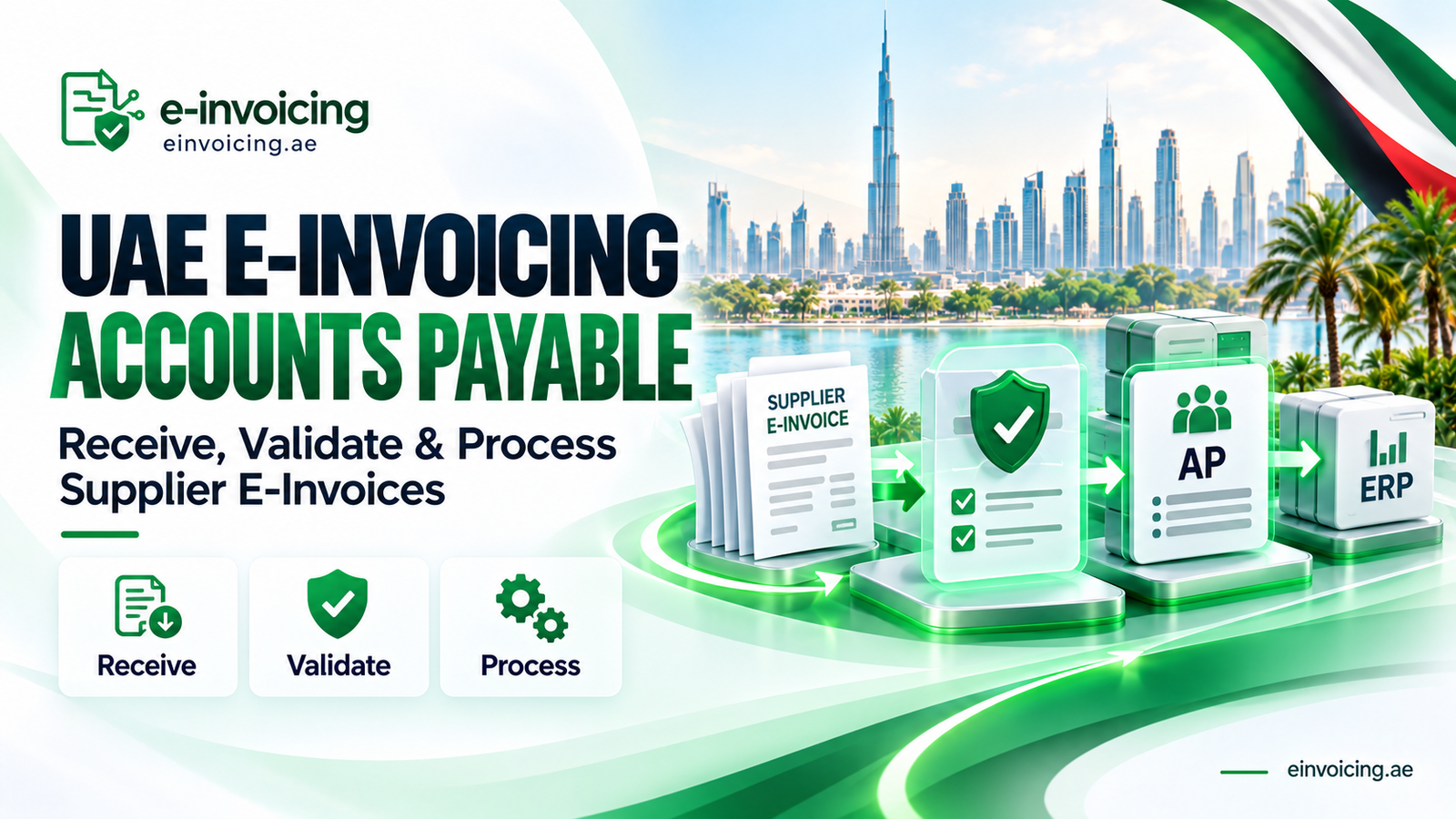
UAE e-invoicing affects accounts payable as well as sales invoicing. In-scope businesses must prepare to receive structured supplier invoices, monitor their status, check VAT treatment and integrate approved purchases into their accounting systems.
For finance managers and AP teams, the objective is not simply receiving an electronic document. It is maintaining a reliable process from supplier invoice receipt through verification, approval, payment and reconciliation.
What Changes for Accounts Payable Under UAE E-Invoicing?
Article 6(3) of Ministerial Decision No. 243 of 2025 requires recipients to process electronic invoices and electronic credit notes through the system, subject to the applicable rollout and exclusions.
Under Section 6.1 of the MoF Electronic Invoicing Guidelines V1.1, each in-scope person appoints one Accredited Service Provider (ASP) for both sending and receiving e-invoices. Separate ASP appointments for accounts receivable and accounts payable are not normally required.
An emailed PDF is not itself a structured eInvoice. Nevertheless, some conventional invoices will continue during the phased transition or for excluded transactions.
How Are Incoming E-Invoices Received and Reported?
The supplier sends structured invoice data through its ASP to the buyer’s ASP. The buyer’s ASP checks the received document, forwards it to the buyer in the agreed format and issues a Message Level Status (MLS) for invoice exchange.
After successful validation, the buyer’s ASP also reports the relevant Tax Data Document (TDD) to the Federal Tax Authority (FTA), which returns a reporting confirmation. Exchange and reporting statuses should be tracked separately.
A successful MLS does not mean the buyer approved the purchase, received the goods or authorised payment. Those remain commercial and accounting decisions.
How Should AP Teams Validate Supplier E-Invoices?
Verify Supplier and Invoice Information
Check the supplier’s legal name, relevant Tax Identification Number (TIN), VAT Tax Registration Number (TRN), invoice number, date, currency, invoice totals and VAT details. Verify any supplier bank-account change independently; never rely solely on payment instructions printed on an invoice. TIN and TRN serve different purposes; do not interchange them. See our mandatory e-invoice fields guide.
Match Purchases and Review VAT
Where practical, match the invoice against the purchase order and goods receipt. For services, check the contract and approved service completion. Confirm quantities, prices, discounts and VAT categories.
These are recommended AP controls, not separate Peppol validation requirements. An electronically valid invoice can still contain an incorrect commercial charge or VAT treatment.
Recommended Supplier E-Invoice Processing Workflow
Stage | AP action | Primary owner |
Receipt | Monitor incoming invoices and missing documents | Accounts Payable |
Technical checks | Check validation, MLS and reporting status | ASP / IT |
Verification | Validate supplier, amounts and VAT treatment | AP / Tax |
Matching | Compare purchase order, receipt and invoice | AP / Procurement |
Approval | Resolve discrepancies and authorise posting/payment | Business approver |
Reconciliation | Match invoice, ledger, credit notes and confirmations | AP / Finance |
Assign exceptions to a named owner and retain a link to the original invoice. Automated matching should flag discrepancies instead of approving them silently.
What If a Supplier E-Invoice Is Incorrect?
Technical rejection and commercial disagreement are different problems. If the buyer’s ASP rejects an invoice during validation, the negative status is returned through the prescribed exchange process. The supplier must investigate and apply the appropriate correction or retransmission procedure.
If the document passes validation but the goods, price or agreed terms are incorrect, AP should hold commercial approval and contact the supplier. Where an issued invoice requires an adjustment, the supplier may need to issue an electronic credit note. Avoid manually changing the received structured document or recording corrected invoices twice.
See our UAE e-invoice validation errors guide.
Do Incoming E-Invoices Automatically Allow Input VAT Recovery?
No. ASP validation does not establish eligibility for input VAT recovery. The buyer must satisfy UAE VAT requirements, including appropriate tax documentation, qualifying business use, applicable payment conditions and restrictions.
Keep technical acceptance, commercial approval and input VAT recovery as separate checks. Our input VAT recovery guide explains the distinction in more detail.
What If the Supplier Implements Before the Buyer?
A large supplier may implement e-invoicing in January 2027 while its smaller customer is not yet required to implement until July 2027.
Section 10.2.2 of the MoF Guidelines requires the supplier to provide a regular Tax Invoice (such as a PDF) alongside the electronic Tax Invoice when the buyer has not implemented e-invoicing. If the buyer has no Participant Identifier, the supplier uses the prescribed endpoint 0235:9900000098.
This is a predefined reporting-only situation rather than ordinary exchange through the buyer’s ASP. The buyer’s later deadline does not automatically move forward. Its AP team may continue processing the conventional document under existing accounting and VAT rules while preparing for ASP onboarding. Match document references to prevent duplicate posting.
How Should Incoming E-Invoices Be Reconciled and Stored?
UAE e-invoice reconciliation should identify missing invoices, duplicate entries, unmatched electronic credit notes and differences between ASP statuses and ERP records.
Ministerial Decision No. 197 of 2026 removed the previous UAE-only storage-location requirement. However, the business must still retain electronic invoices, credit notes and associated data for the applicable period and make them available to the FTA upon request. Outsourcing storage to an ASP does not remove that responsibility. Read the MoF amendment announcement.
When Must Businesses Be Ready?
In-scope business | ASP appointment | Mandatory implementation |
Revenue of AED 50 million or more | 30 October 2026 | 1 January 2027 |
Revenue below AED 50 million | 31 March 2027 | 1 July 2027 |
Prepare both incoming and outgoing processes for your applicable phase; not every supplier invoice will enter the electronic workflow, particularly where an exclusion applies.
Accounts Payable Readiness Checklist
Before go-live, verify supplier master data; confirm ASP-to-ERP connectivity; configure PO matching, VAT reviews and approval permissions; test negative MLS messages, credit notes and duplicates; and confirm record retrieval and reconciliation. Train AP staff to distinguish technical failures from commercial disputes.
Use our ERP preparation guide to plan integration testing.
Key Takeaways
UAE e-invoicing accounts payable compliance requires reliable receiving processes, not automatic payment approval. Finance teams must monitor exchange and reporting, verify invoices, maintain VAT controls and resolve exceptions before posting or payment.
To review supplier-data readiness, incoming invoice workflows and integration gaps, request an einvoicing.ae readiness assessment.