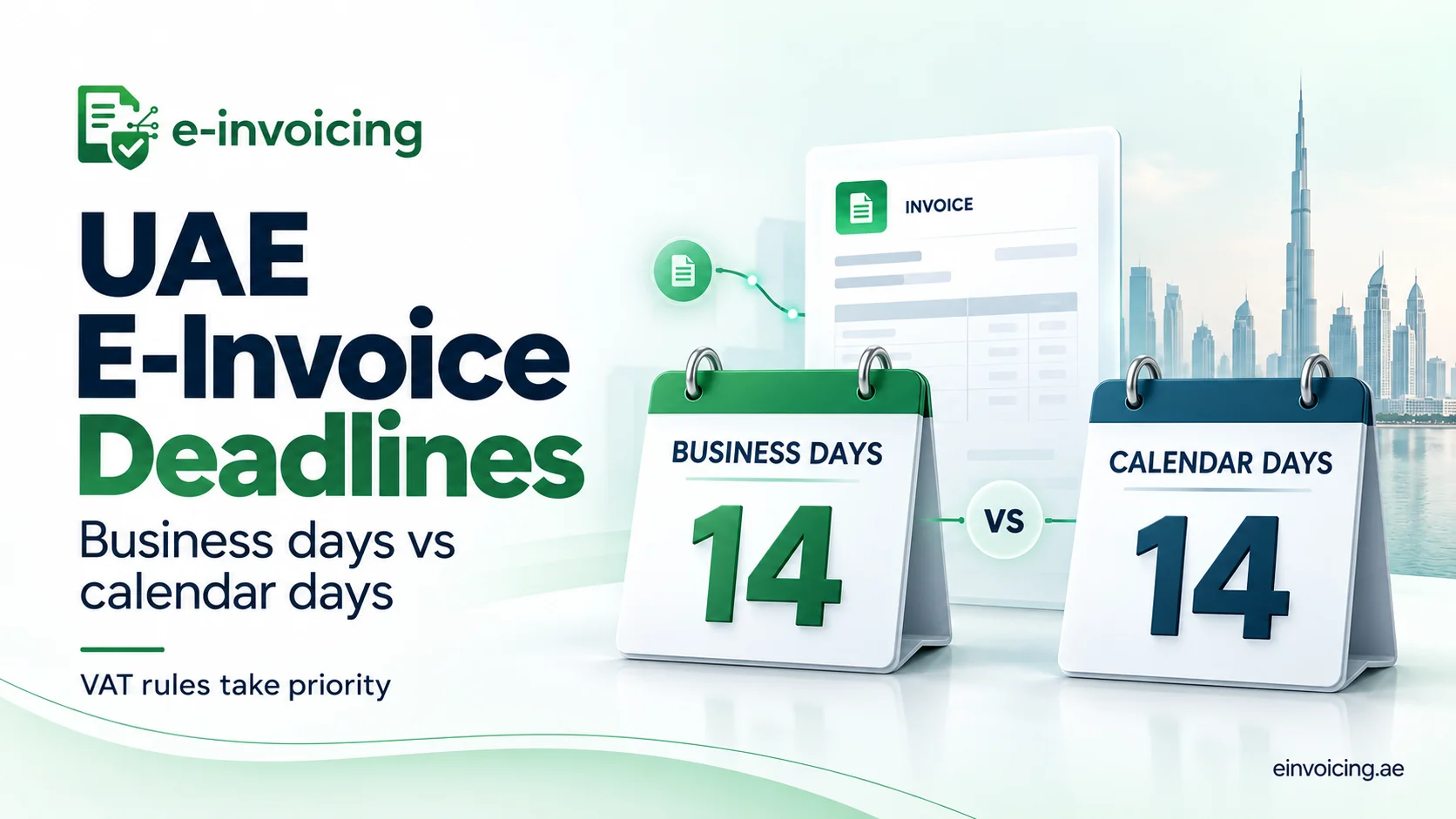
UAE e-invoice deadlines depend on the issuer’s VAT status, the document and the transaction. The amended e-invoicing framework provides a 14-business-day period, subject to applicable VAT deadlines. Ordinary VAT tax invoices generally must be issued within 14 calendar days from the VAT date of supply. Where electronic invoicing applies, transmission must also meet the applicable VAT timeline.
Businesses should identify the correct legal rule before configuring invoice reminders. Applying 14 business days to every document could produce incorrect deadlines.
What changed under Ministerial Decision 197?
However, Article 6(5) remains expressly subject to Article 6(4). Under Article 6(4), VAT-registered issuers must issue and transmit electronic invoices and electronic credit notes within the timelines prescribed by VAT law. The amendment therefore does not give every business an additional allowance for weekends.
Compare the applicable invoice deadlines
The following table summarises common situations. Confirm that the issuer and transaction fall within the applicable e-invoicing regime before applying its requirements.
Document or situation
Applicable period
Starting event
Key qualification
In-scope invoice from a non-VAT-registered issuer
14 business days
Date of Business Transaction
Article 6(5), subject to Article 6(4)
Ordinary VAT tax invoice
14 calendar days
VAT date of supply
Article 67; applicable exceptions remain relevant
Qualifying VAT summary invoice
14 calendar days after month-end
End of the calendar month containing the supplies
Article 59(6) and 59(13)(b); multiple supplies to the same customer
Tax credit note under Article 62(2)
14 calendar days
Relevant Article 61(1) event
Applies to the specified output-tax adjustment
These periods derive from the amended e-invoicing decision, VAT legislation and the FTA’s calendar-day clarification.
Commercial invoices for supplies exempt from, or outside the scope of, VAT require separate analysis. VAT registration alone does not make every document a tax invoice. Where the applicable timing remains unclear, obtain clarification before assigning either period automatically.
Identify the correct starting date
Decision 243 defines the Date of Business Transaction as the earlier of the transaction occurring or payment being received.
The VAT date of supply follows Articles 25 and 26. Depending on the transaction, goods delivery, service completion, payment receipt or an earlier tax invoice can determine that date.
Contracts involving periodic payments or consecutive invoices have specific rules. For periodic contracts, Article 26(1) considers invoice issuance, the payment due date specified on the invoice, payment receipt and one year after provision; the earliest relevant date determines the tax point.
The ERP posting date, customer approval date and contractual payment deadline should not automatically replace these legal triggers. Record the relevant commercial events separately so the system can calculate the correct deadline.
Apply summary-invoice and credit-note rules separately
Qualifying VAT summary invoices can cover multiple supplies to the same customer. Article 59(13)(b) requires issuance and delivery within 14 days after the relevant calendar month ends. Do not assume this month-end treatment also applies to non-VAT commercial summary invoices.
Traditional simplified tax invoices have a same-day rule. However, Article 59(16) disapplies their enabling provisions for mandatory or voluntary electronic tax invoices, while leaving the qualifying summary-invoice provisions applicable.
Where an Article 61(1) event requires a tax credit note reducing output VAT, Article 62(2) requires issuance within 14 calendar days of that event. Relevant events include qualifying cancellations and changes in consideration. Other VAT adjustments, including bad-debt relief, follow separate provisions.
For returned supplies, Article 61(1)(d) requires both the return of goods or services and return of consideration, in full or part. Physical return alone does not automatically establish that particular adjustment.
For non-VAT electronic credit notes, amended Article 6(5) still refers to the Date of Business Transaction. It does not expressly define a separate starting event for every later correction. Obtain clarification rather than assuming discovery of an error starts a new 14-business-day period.
Count weekends and federal holidays correctly
Business days exclude federal government weekends and official holidays. Saturday and Sunday are federal weekend days; Friday normally counts. A company’s own opening hours do not determine the statutory calendar.
Article 49 of the Tax Procedures Law excludes the triggering day. If the final day is not a business day, the period extends to the next business day. Calendar-day periods still include intervening weekends and holidays. Use the Gregorian calendar and maintain announced federal holidays in the ERP.
Three worked deadline examples
These hypothetical examples assume the issuer is already within mandatory e-invoicing, the transaction is in scope, current rules remain unchanged and no federal holiday affects the period. They exclude the triggering day and are illustrations, not official rulings.
Ordinary VAT invoice
A VAT-registered supplier completes a one-off service on Monday, 6 September 2027, without earlier payment or a tax invoice. No exception applies. Fourteen calendar days expire on Monday, 20 September 2027. Issuance and transmission must meet that deadline.
Non-VAT-registered supplier
An eligible non-VAT-registered supplier completes a transaction on Monday, 6 September 2027, without earlier payment. Count four business days on 7–10 September, five on 13–17 September and five on 20–24 September. The deadline is Friday, 24 September 2027.
Qualifying monthly VAT summary
Multiple September 2027 supplies to the same customer qualify for one summary tax invoice. September ends on Thursday, 30 September. The issuance and delivery deadline is Thursday, 14 October 2027.
Separate document deadlines from implementation dates
Issuance, transmission and FTA reporting are distinct obligations. Saving an invoice in the ERP does not demonstrate successful transmission. Article 6(6) addresses reporting separately, while Article 6(7) requires obligations to be fulfilled through an Accredited Service Provider, or ASP.
ASP appointment and mandatory implementation dates govern onboarding. They do not replace individual invoice deadlines. Existing VAT invoicing obligations also continue before a business enters mandatory e-invoicing.
For example, the FTA confirms that the in-scope businesses with annual revenue of at least AED 50 million were required to appoint an ASP by 30 October 2026 and must implement e-invoicing by 1 January 2027.
Configure practical ERP controls
- Assign separate deadline rules to each document category.
- Record transaction, payment, supply and adjustment dates.
- Maintain federal holidays and test both counting methods.
- Set reminders before legal deadlines, allowing correction time.
- Retain issuance timestamps, transmission acknowledgements and reporting confirmations.
- Escalate delayed or rejected documents to named finance, IT and ASP contacts.
Reconcile ERP documents against transmission and reporting records daily. Keep unresolved invoices visible until correction and resubmission are complete.