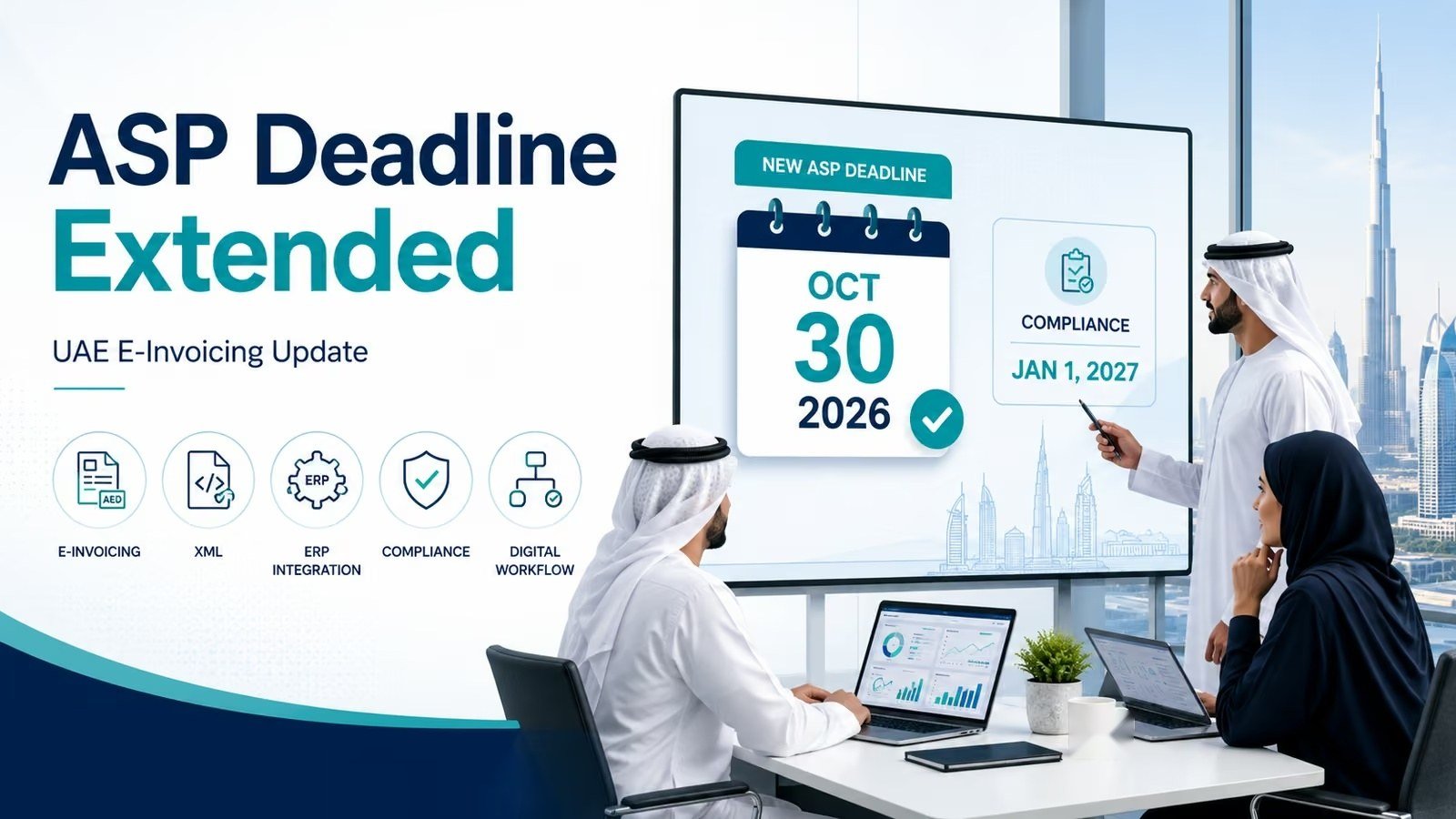
As of June 2026, the UAE Ministry of Finance has confirmed that the UAE ASP deadline has been extended to 30 October 2026 for persons subject to UAE e-invoicing whose annual revenues are equal to or exceed AED 50 million. The previous deadline was 31 July 2026, and the change was introduced through Ministerial Decision No. (66) of 2026, amending Ministerial Decision No. 244 of 2025. The mandatory implementation date for this category remains 1 January 2027.
This update gives UAE businesses more time to appoint an Accredited Service Provider UAE, but it does not reduce the work required for UAE e-invoicing compliance. ERP readiness, invoice data cleanup, XML invoice preparation, VAT configuration, internal testing, and finance/IT coordination still need to start early.
Quick Summary
- New UAE ASP deadline: 30 October 2026 for persons whose annual revenues are equal to or exceed AED 50 million.
- Previous deadline: 31 July 2026, now amended by Ministerial Decision No. (66) of 2026.
- Mandatory compliance date: Still 1 January 2027 for the AED 50 million or more revenue category.
- What businesses must prepare: ASP selection, ERP readiness, invoice data fields, VAT setup, XML readiness, and testing.
- Immediate action: Start a UAE e-invoicing readiness review now instead of waiting until October.
What Changed in the UAE ASP Deadline?
The MoF announced targeted amendments to the UAE e-invoicing decisions, including an extension of the ASP appointment deadline to 30 October 2026 for persons subject to the Electronic Invoicing System whose revenue is equal to or exceeds AED 50,000,000.
In simple terms, businesses in this revenue category now have extra time to choose an ASP and complete provider onboarding steps. However, the extension only applies to the ASP appointment date. It does not remove the need to prepare systems, invoice data, internal processes, and finance/IT teams.
The MoF also stated that the extension follows an assessment of market readiness and feedback from businesses about the need for broader technical options and competitive pricing. The Ministry noted that 32 service providers had already been approved, with more in the final stages of accreditation.
Does the UAE E-Invoicing Deadline Change?
No. The UAE e-invoicing deadline for mandatory implementation remains unchanged for persons whose revenue is equal to or exceeds AED 50 million. Under Ministerial Decision No. (66) of 2026, this category must implement the Electronic Invoicing System by 1 January 2027.
This distinction is important. The ASP deadline is about appointing your service provider. The compliance deadline is about being operationally ready to issue, exchange, process, and manage compliant eInvoices.
For persons whose revenue is less than AED 50 million, Ministerial Decision No. 244 of 2025 states that the ASP appointment deadline is 31 March 2027 and implementation is required by 1 July 2027. Government entities must appoint an ASP by 31 March 2027 and implement by 1 October 2027.
What Is an Accredited Service Provider in UAE E-Invoicing?
An Accredited Service Provider UAE is a provider approved to support electronic invoicing services under the UAE framework. In practice, the ASP helps your business connect to the UAE digital invoicing system.
The MoF defines an eInvoice as structured invoice data issued and exchanged electronically between supplier and buyer and reported electronically to the UAE Federal Tax Authority. The MoF also states that PDFs, Word documents, images, scanned copies, and emails are not eInvoices.
Your ASP supports the flow between your ERP or accounting system and the e-invoicing network. In the UAE model, businesses can access EmaraTax to select their preferred ASP, enter into a commercial agreement, complete onboarding, and begin exchanging eInvoices.
A practical ASP relationship usually affects:
- invoice exchange between supplier and buyer;
- XML invoice UAE readiness;
- structured eInvoice validation;
- integration with ERP/accounting systems;
- status messages and error handling;
- tax data reporting readiness and Corner 5 reporting flow.
The MoF’s eInvoicing model explains that the supplier submits eInvoice data to its UAE Accredited Service Provider, which validates the invoice data and converts it into the UAE standard XML eInvoice format if received in another agreed format.
Does This Mean Businesses Can Delay Preparation?
No. The extension should be used for better preparation, not late preparation.
Many businesses underestimate how much work happens before ASP onboarding. Even if a business in the AED 50 million or more revenue category appoints an ASP by 30 October 2026, its ERP may still need configuration, invoice data may need cleanup, and finance/IT teams may need time for testing before the 1 January 2027 implementation deadline.
A UAE e-invoicing compliance project usually requires:
- reviewing current invoicing workflows;
- checking ERP readiness for UAE e-invoicing;
- cleaning customer and supplier master data;
- mapping invoice fields;
- reviewing VAT and tax configuration;
- preparing XML or structured invoice flows;
- testing with the ASP before go-live.
The MoF encourages businesses to take prompt action by selecting their ASP, completing contractual arrangements, and initiating onboarding to benefit from available eInvoicing capabilities.
What Businesses Must Do Now
Use the extension period to complete these steps:
1. Review your current invoicing process
Identify how invoices and credit notes are created, approved, sent, corrected, and stored.
2. Check ERP/accounting software readiness
Confirm whether your system can generate or export structured invoice data, not only PDF invoices.
3. Prepare invoice data fields
Review customer names, TRNs/TINs, addresses, item descriptions, VAT categories, tax rates, invoice numbers, and credit note references.
4. Review VAT and tax configuration
Check VAT codes, exempt/out-of-scope treatment, free zone transactions, exports, discounts, and credit notes.
5. Identify ASP integration needs
Decide whether you need API integration, middleware, file upload, portal use, or a hybrid model.
6. Create an internal project team
Include finance, tax, IT, operations, procurement, and management.
7. Book a readiness assessment
A structured review helps you understand gaps before choosing an ASP or changing your ERP setup.
Common Mistakes to Avoid
Avoid these errors:
- waiting until October 2026 to start;
- assuming PDF invoices are enough;
- assuming your current ERP is automatically ready;
- not checking XML invoice capability;
- ignoring customer and supplier master data;
- choosing an ASP only based on price;
- excluding IT from finance-led decisions;
- testing only one standard invoice scenario.
The biggest risk is not only choosing an ASP late. The bigger risk is choosing one without understanding your systems, data quality, VAT logic, and integration requirements.
How eInvoicing.ae Can Help
eInvoicing.ae helps UAE businesses prepare for the UAE digital invoicing rollout with practical, implementation-focused support.
We can help with:
- UAE e-invoicing readiness assessment;
- ASP selection support;
- ERP integration review;
- invoice data gap analysis;
- VAT and compliance readiness;
- implementation roadmap for finance and IT teams.
This gives your business a clear view of what must be fixed before ASP onboarding and mandatory implementation.