
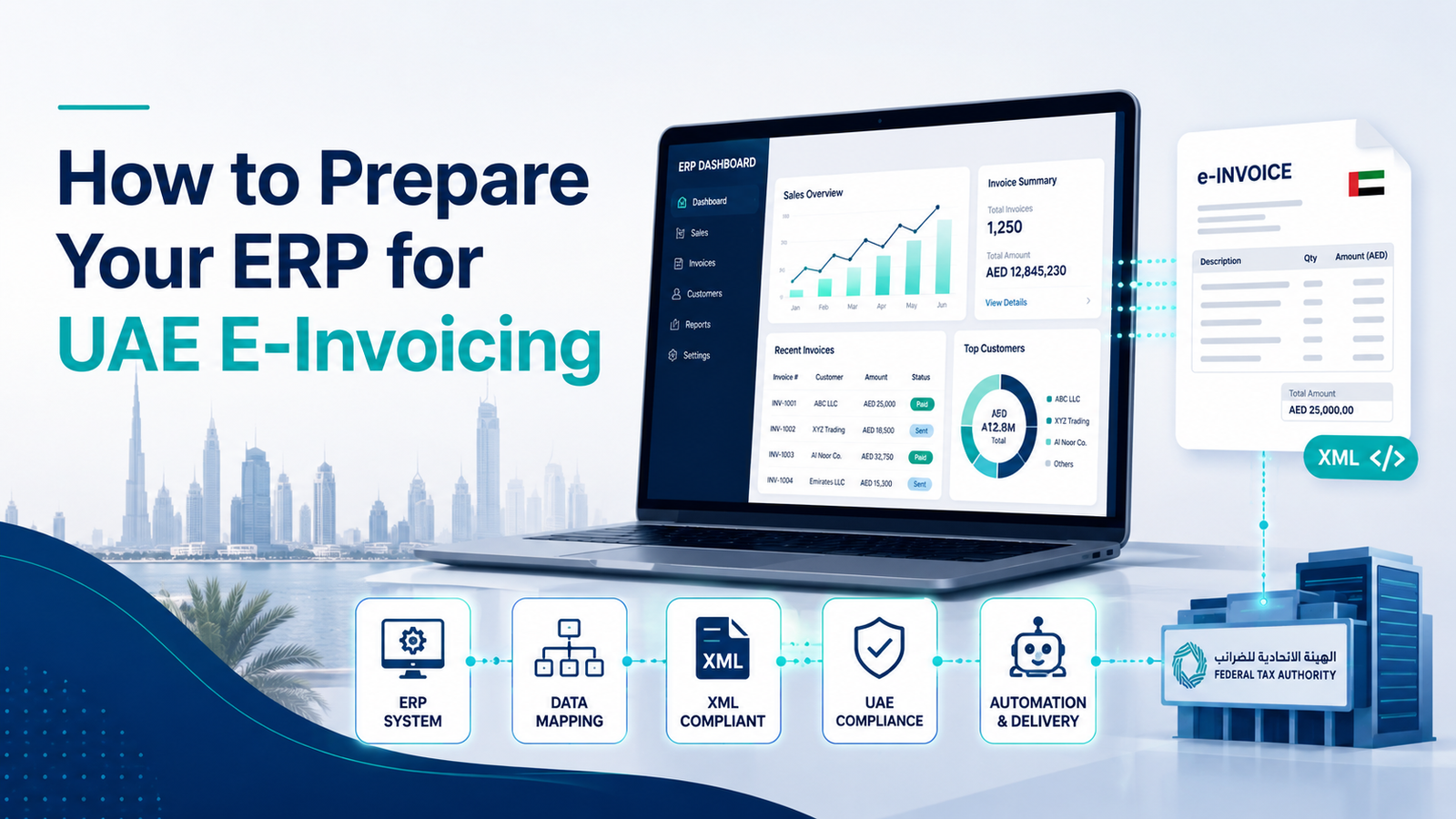
To prepare ERP for UAE e-invoicing, businesses need more than a software update. Your ERP or accounting system must capture the right invoice data, generate structured electronic invoices, connect with an Accredited Service Provider (ASP), and support reliable validation, exchange, reporting, and archiving.
UAE e-invoicing is moving from planning to execution. The Ministry of Finance (MoF) confirms that eInvoices are structured invoice data exchanged electronically and reported to the Federal Tax Authority (FTA); PDFs, Word documents, scans, images, and emails are not eInvoices.
At-a-glance
- ERP readiness means your system can produce complete, structured invoice data.
- UAE e-invoices use structured formats such as XML; PDF-only invoicing is not enough.
- The UAE model uses a 5-corner framework involving supplier, supplier ASP, buyer ASP, buyer, and FTA.
- Businesses must onboard with an ASP through Emara Tax and test invoice exchange/reporting before go-live.
- Pilot and voluntary implementation start from 1 July 2026; mandatory phases begin in 2027 based on revenue thresholds.
- Early ERP preparation reduces invoice rejection, manual rework, VAT errors, and compliance risk.
Why ERP readiness matters for UAE e-invoicing
Your ERP is usually the source of invoice data: customer details, TRN/TIN, VAT codes, item descriptions, prices, discounts, credit notes, and payment terms.
If that data is incomplete or inconsistent, your e-invoicing project will suffer. Even a strong ASP cannot fix poor master data or incorrect tax logic automatically.
ERP readiness supports:
- accurate invoice validation;
- smoother ASP integration;
- VAT compliance and audit readiness;
- fewer manual corrections;
- better accounts payable and receivable automation.
Finance, VAT, IT, procurement, sales, and operations must work together. UAE e-invoicing is a business process change, not only an IT project.
Key UAE e-invoicing requirements your ERP must support
As of May 2026, based on current MoF guidance, businesses should prepare for:
- Structured electronic invoices instead of PDF-only invoices;
- XML invoice data that systems can read and exchange;
- UAE Peppol / PINT-AE alignment, based on published UAE Peppol specifications.
- ASP connectivity for sending, receiving, and exchanging eInvoices;
- invoice and credit note data accuracy;
- testing of invoice exchange and reporting before go-live;
- recordkeeping and retrieval for compliance and audits.
The MoF Guidelines specifically advise businesses to complete ERP/accounting changes, integrate with ASP systems, test invoice exchange/reporting, and establish error-resolution governance.
Step-by-step ERP preparation process
- Review your current invoicing workflow
Map how invoices are created, approved, sent, corrected, and archived today. - Identify all ERP/accounting systems
Include SAP, Oracle, Microsoft Dynamics, Odoo, Zoho, ERPNext, QuickBooks, Tally, POS tools, and custom billing systems. - Check XML readiness
Confirm whether your system can generate structured invoice data or needs middleware. - Review VAT and tax configurations
Check VAT rates, tax categories, exemptions, reverse charge, and free zone scenarios. - Clean customer and supplier master data
Fix missing names, TRNs/TINs, addresses, country codes, and duplicate records. - Review invoice fields and credit notes
Ensure your ERP captures mandatory invoice data and links credit notes to the correct transactions. - Assess API and integration readiness
Confirm whether your ERP can connect via API, middleware, file transfer, or portal. - Evaluate ASP connection requirements
Choose a UAE accredited service provider and confirm integration responsibilities. - Test invoice generation and validation
Test multiple scenarios, not just one standard invoice. - Create an implementation roadmap
Assign owners, deadlines, testing stages, and go-live controls.
Common ERP systems used in UAE
Many UAE businesses use SAP, Oracle, Microsoft Dynamics, Odoo, Zoho, ERPNext, QuickBooks, and Tally.
Enterprise ERPs such as SAP, Oracle, and Dynamics may support deeper integration but still require configuration, data mapping, testing, and ASP coordination.
SME platforms such as Zoho, Odoo, QuickBooks, ERPNext, and Tally may need connectors, middleware, or portal-based workflows. Businesses should not assume their current software is automatically compliant.
Legacy or heavily customized ERPs carry higher risk because invoice data may be fragmented across modules, branches, spreadsheets, or manual approval workflows.
Signs your ERP is not ready
Your ERP may not be ready if:
- invoices are still generated manually or as PDF-only files;
- customer TRNs, TINs, or addresses are incomplete;
- VAT codes are inconsistent;
- credit notes are not linked properly;
- your ERP cannot generate structured XML invoice data;
- there is no API, middleware, or ASP integration plan;
- finance teams rely heavily on manual corrections;
- POS, ERP, and accounting systems do not sync cleanly.
How We can help
We can support UAE businesses with:
- ERP readiness assessment;
- invoice data gap analysis;
- ASP selection advisory;
- ERP integration planning;
- VAT and e-invoicing compliance review;
- implementation roadmap;
- coordination between finance, IT, ERP vendor, and ASP.