
UAE e-invoicing scope is the first thing to get clear—before you talk to vendors, plan ERP work, or change invoicing processes. If you misunderstand what’s in scope (and what isn’t), you risk building the wrong solution, missing deadlines, or creating rework across finance and IT.
In this guide, you’ll learn what B2B, B2G, and B2C mean in the UAE e-invoicing programme, what’s included and excluded as of February 2026, and how to quickly decide whether your business is affected—plus what to prepare in your systems.
At-a-glance
- UAE e-invoicing uses structured invoice data (not PDFs/Word/images/scans).
- B2B and B2G transactions are in scope for e-invoicing (unless specifically excluded).
- B2C (sales to consumers) is not in scope until a future ministerial decision (as per current implementation decision).
- UAE e-invoicing is described as mandatory for any Person conducting Business in the UAE, regardless of VAT registration status, unless excluded.
- Key verified exclusions include sovereign government activities, specific airline passenger/ancillary services, certain air cargo (temporary), and certain VAT-exempt/zero-rated financial services.
- Pilot + voluntary participation starts 1 July 2026, then mandatory phases begin in 2027 (based on revenue thresholds).
- You’ll need clean master data (TIN/TRN, buyer/seller details), invoice/credit note workflows, and storage controls.
Definitions: what “e-invoicing” means in the UAE (structured e-invoice vs PDF)
In the UAE programme, an eInvoice is structured invoice data issued and exchanged electronically between supplier and buyer and reported electronically to the Federal Tax Authority (FTA).
A key point: PDFs are not eInvoices. The MoF states that “unstructured invoice formats such as pdf, word document, images, scanned copies and emails are not eInvoices.”
Why “structured data” matters (in practical terms)
A structured e-invoice is designed so systems can automatically validate and process it. That affects:
- Invoice validation (missing fields, incorrect VAT fields, wrong identifiers)
- Transmission and status tracking (sent/received/accepted/rejected)
- Reporting of invoice data to the FTA through the e-invoicing system/approved process
If your current invoicing is “PDF by email,” you should treat UAE e-invoicing as an operating model change, not just a document format change.
UAE e-invoicing scope: what’s included (the simple rule)
The formal scope (in the legislation) is broad: it applies to any Person conducting Business in the State for every Business Transaction, except where the Person or transaction is excluded.
The MoF Guidelines (dated 23 February 2026) also explain that electronic invoicing is mandatory for any Person conducting Business in the UAE for every Business Transaction, regardless of where they are established, unless excluded.
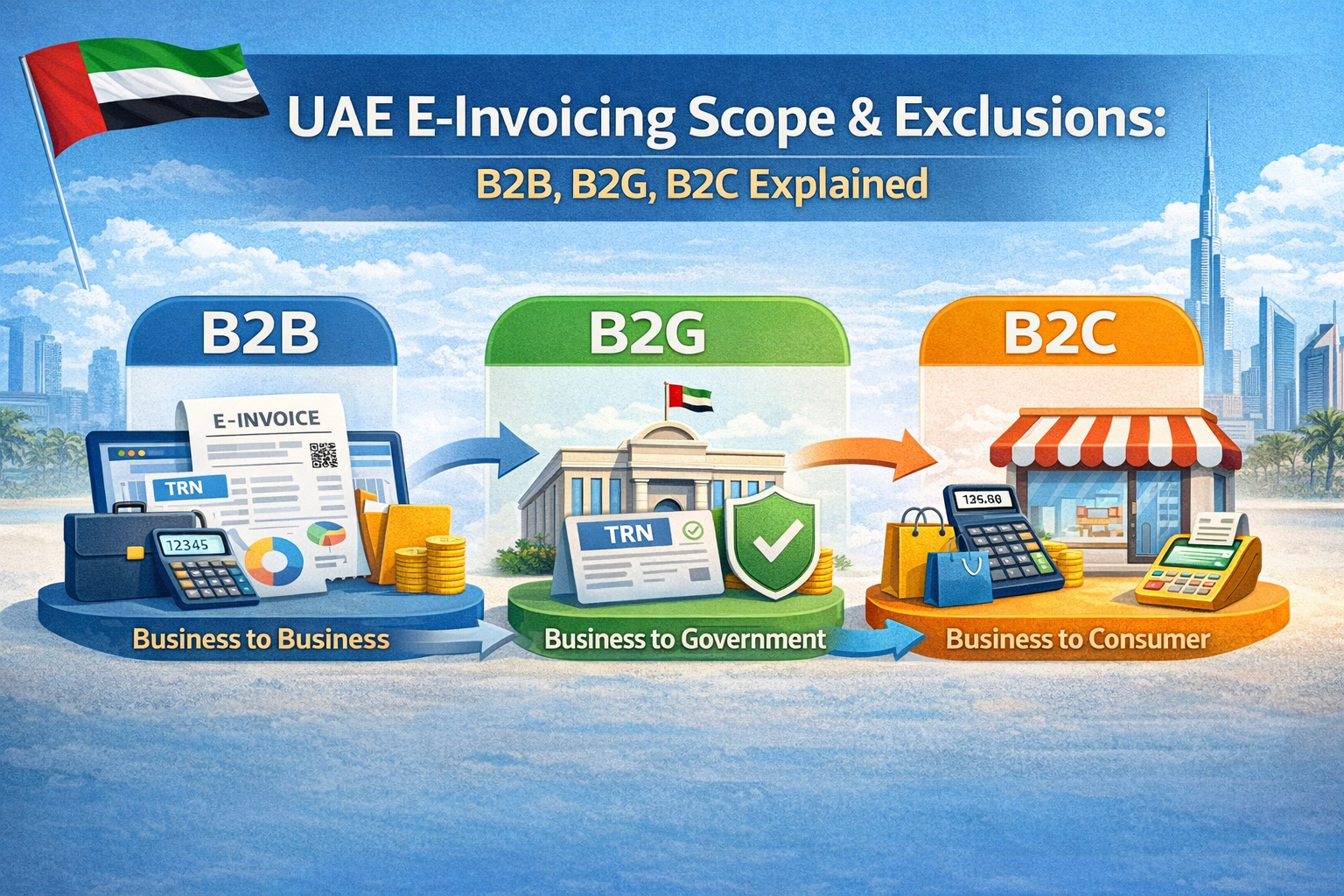
B2B explained (B2B e-invoicing UAE)
B2B (Business-to-Business) means you sell goods/services to another business (a “Person” conducting business).
Typical B2B examples
- A trading company invoicing a corporate customer
- A consultancy invoicing another company for services
- A logistics company invoicing a distributor or importer
- A contractor invoicing a developer or subcontractor
What B2B usually means for your invoicing process
Under the UAE framework (as of Feb 2026), B2B transactions are in scope for e-invoicing unless excluded.
Practically, that means you should plan for:
- Structured invoice generation (your accounting/ERP/POS must produce compliant e-invoice data)
- Exchange and reporting via the UAE e-invoicing system (typically via an Accredited Service Provider workflow)
- Credit notes following the same approach when you cancel/reduce a transaction
Important nuance (buyer readiness): The MoF Guidelines state that a customer’s e-invoicing onboarding status or tax registration status does not change the supplier’s e-invoicing obligations for a Business Transaction.
B2G explained (B2G e-invoicing UAE)
B2G (Business-to-Government) means you sell to a UAE Government Entity (federal or local) in the context of a business transaction (e.g., procurement contracts).
Typical B2G examples
- Supplying goods to a ministry or government authority
- Maintenance/services contracts for a government entity
- Consulting/professional services for public bodies
The MoF Guidelines explicitly note that goods and services supplied to Government Entities (for example via government procurement portals) are subject to electronic invoicing.
The key thing to watch in B2G
Not every “government-related” activity is automatically in scope, because one of the verified exclusions is sovereign government activity. But standard procurement and business transactions with government entities are generally treated as in-scope.
B2C explained (B2C e-invoicing UAE)
B2C (Business-to-Consumer) means you sell to an individual acting as a consumer (a natural person not conducting business).
Where B2C stands today (as of Feb 2026)
Under Ministerial Decision No. 244 of 2025, Business-to-Consumer Transactions are not subject to the Electronic Invoicing System until a later decision is issued by the Minister. It also states that a Person engaged exclusively in such transactions is not subject until that time.
The MoF Guidelines also explain that supplies to or from natural persons who are not in business are not within scope, and there is no obligation to issue an Electronic Invoice for a supply made to a consumer.
Practical B2C examples
- Retail store sales to individual consumers
- Restaurant/hospitality sales to walk-in customers
- Consumer ecommerce orders shipped to individuals
What to do if you’re mixed (B2B + B2C): If you have both B2B and B2C revenue, you should plan for e-invoicing for the B2B/B2G side, while monitoring for future announcements on B2C timing.
Scope vs exclusions: what’s excluded (verified) and what’s “not yet confirmed”
Verified UAE e-invoicing exclusions (as of Feb 2026)
Ministerial Decision No. 243 of 2025 lists Excluded Transactions including:
- Business transactions conducted by Government Entities in a sovereign capacity and not in competition with the private sector
- International passenger transportation services by an Airline where an Electronic Ticket is issued
- Ancillary passenger services by an Airline where an Electronic Miscellaneous Document (EMD) is issued
- International air cargo transportation services where an Airway Bill is issued (temporary exclusion for 24 months from the date the system becomes effective)
- Financial services that are VAT-exempt or zero-rated under the VAT Executive Regulation (Guidelines add clarification on which exports qualify)
- Any other business transaction as may be determined by the Minister
Excluded persons (not fully listed yet)
Ministerial Decision No. 243 notes that the category of Excluded Persons will be determined by a separate decision issued by the Minister. So, as of February 2026, don’t rely on assumptions—watch for additional decisions/updates.
A special “timing” exception: VAT group intra-group grace period
The MoF Guidelines introduce a temporary grace period for transactions between members of the same VAT group: a 24-month period starting 01 January 2027 during which e-invoicing obligations won’t be required for intra-group transactions. It clarifies this affects timing only and does not remove those transactions from scope.
Practical decision guide: “Are you affected?” checklist + next steps
Use this quick checklist to assess whether UAE e-invoicing scope applies to you.
Step 1: Do you issue invoices for business transactions in the UAE?
- If you sell goods/services as a business (to other businesses or to government), you are likely in scope unless a verified exclusion applies.
Step 2: Who are your customers?
- Mostly businesses → B2B in scope
- government entities → B2G in scope
- only consumers (individuals not in business) → B2C currently not subject until later decision
Step 3: Are you in an excluded transaction category?
Check if your invoices relate to one of the verified excluded transaction types (sovereign government activities, specific airline services, certain financial services). If yes, confirm the details carefully because exclusions are specific.
Step 4: When is your “mandatory e-invoicing UAE timeline” milestone?
From Ministerial Decision No. 244 of 2025 and the MoF Guidelines:
- Pilot starts: 1 July 2026
- Voluntary participation: from 1 July 2026
- Mandatory phases:
- Revenue ≥ AED 50,000,000: appoint ASP by 31 July 2026; implement by 1 Jan 2027
- Revenue < AED 50,000,000: appoint ASP by 31 Mar 2027; implement by 1 Jul 2027
- Government entities: appoint ASP by 31 Mar 2027; implement by 1 Oct 2027
Systems impact what finance, accounting, ERP and POS teams should prepare
Even for non-technical readers, it helps to know what changes in the back office.
1) You’ll need identifiers: TIN vs TRN (and why they matter)
The Guidelines explain that your participant identifier is based on your Tax Identification Number (TIN) and that taxpayers registered for tax have already been assigned a TIN; it also notes the TIN is the first 10 digits of the TRN.
From the Mandatory Fields document, the seller electronic address is identified as the TIN, and tax identifiers (for UAE businesses registered under tax) should provide the TRN.
Action: make sure your master data stores these reliably (and consistently across entities and branches).
2) Customer master data quality becomes “compliance critical”
The Mandatory Fields list includes buyer and seller details such as:
- Legal names
- Electronic address/identifier fields (TIN-based)
- Address fields (city, country subdivision, country code)
- Buyer/seller TRN where tax-registered
Action: clean duplicates, validate TRN formats, standardize address fields, and map all required identifiers to the correct entity.
3) Invoices and credit notes must follow the e-invoicing workflow
Ministerial Decision No. 243 requires issuers to issue/transmit eInvoices for business transactions and issue/transmit electronic credit notes for cancellations, reductions, returns, or errors.
It also states eInvoices/eCredit Notes must be issued and transmitted through the system within 14 days from the Date of Business Transaction (subject to VAT-registrant timing under VAT law).
Action: define when a credit note is used, who approves it, and how it’s transmitted and stored.
4) Storage/archiving is part of the scope
Ministerial Decision No. 243 states that persons subject to the system must store electronic invoices, credit notes, and associated data within the State according to the timeline prescribed under the Tax Procedures Law.
Action: confirm where your invoice archive is hosted, how long you retain, and how you can retrieve records quickly for audit/controls.
5) Don’t forget “human-readable” needs
Because eInvoices are in XML, the Guidelines note buyers may still request a separate Tax Invoice or Commercial Invoice (non-eInvoice) during transition, e.g., to support internal processes.
Action: plan for a printable/PDF rendering for business users—without treating the PDF as the “official” eInvoice.
Common mistakes (and how to avoid them)
- Assuming “PDF = eInvoice.” It’s not. Treat PDFs as a rendering, not the compliant payload.
- Thinking only VAT registrants are in scope. Current MoF guidance describes scope as applying regardless of VAT registration status unless excluded.
- Ignoring inbound invoices (AP). The scope includes sending and receiving responsibilities; operational readiness needs both AR and AP planning.
- Leaving master data clean-up until go-live. Most failures are preventable with early data validation and mapping to mandatory fields.
Missing special cases (VAT groups / airlines / financial services). Some exclusions and timing rules are specific—apply them only when they match your reality.