

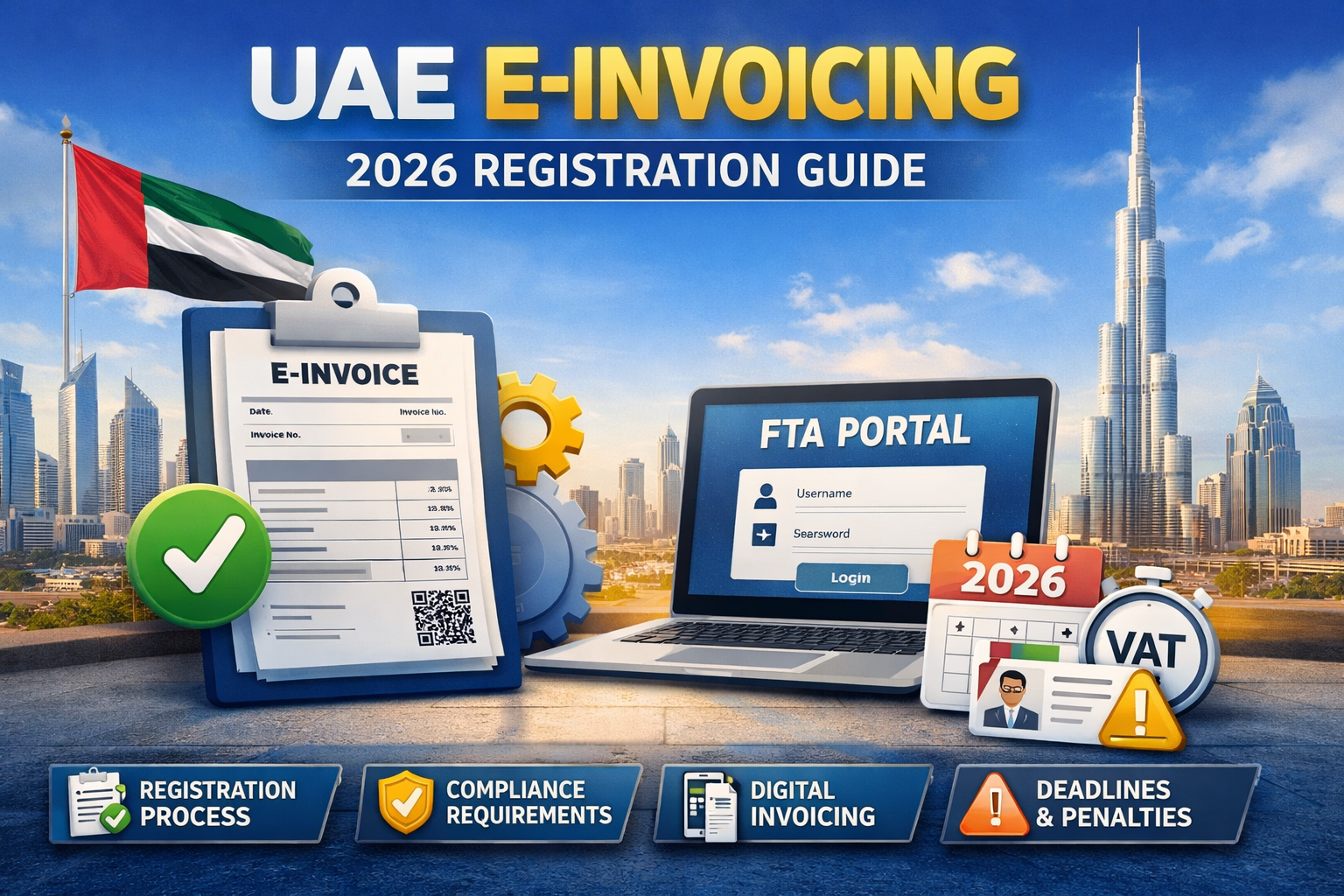
The UAE is entering a new era of digital tax compliance, where traditional paper invoices and unstructured PDF files will no longer be sufficient. Beginning in July 2026, all VAT-registered businesses must issue, transmit, and store invoices digitally in compliance with the Federal Tax Authority (FTA) e-invoicing regulations and the Digital Tax Compliance Environment (DCTCE). This shift is part of the UAE’s ongoing digital transformation to enhance transparency, improve
tax compliance, and streamline financial operations for businesses of all sizes.
If you are a business owner, accountant, or finance professional in the UAE, understanding how to register for UAE e-invoicing is critical. This comprehensive step-by-step guide will cover everything you need to know about e-invoicing
registration, system requirements, compliance procedures, common mistakes, and practical tips to ensure your business is fully prepared for the July 2026 mandate.
What is UAE E-Invoicing and Why It Matters
- E-invoicing UAE refers to the electronic creation, transmission, and storage of invoices in a structured format that is readable by accounting systems and compliant with FTA requirements. Unlike traditional paper invoices or unstructured PDFs, e-invoices:
- Include all mandatory fields such as VAT details, TRN numbers, and invoice identifiers
- Are digitally signed to ensure authenticity
- Can be automatically validated for errors or discrepancies
- Are stored in a secure, machine-readable format for audits
- The move to e-invoicing is designed to:
- Reduce tax evasion and fraudulent invoicing
- Improve real-time tracking of business transactions
- Streamline VAT reporting and filing
- Minimize administrative workload
- Enable faster payments and smoother business operations
All VAT-registered businesses, suppliers to government entities, and entities involved in self-billing arrangements are required to comply. Non-compliance can result in penalties, fines, and rejection of invoices, making early preparation
crucial.
Who Must Register for UAE E-Invoicing
The FTA has clarified which businesses must register for e-invoicing:
- VAT-Registered Businesses: Any business issuing taxable invoices must comply. This includes standard-rated, zero-rated, and export invoices.
- Suppliers to Government Entities: All companies providing goods or services to UAE government bodies must issue e-invoices.
- Self-Billing Arrangements: If a buyer generates invoices on behalf of the supplier, both parties must ensure invoices meet the structured digital requirements.
- Businesses not falling under these categories, such as non-VAT-registered entities or purely B2C transactions, are currently not required to issue e-invoices, though preparation is recommended for future updates.
Step 1: Assess Your Current Invoicing System
Before you register, evaluate how your invoices are currently generated and processed.
- Are invoices manually created in Excel or Word?
- Are PDFs being emailed to customers?
- Does your accounting system support structured invoice formats such as XML or UBL?
- Can your current system integrate with FTA-approved platforms or access points?
- This assessment will help determine whether you need to upgrade your accounting system or integrate with a certified e-invoicing solution.
Step 2: Prepare Your Business and Technical Information
To successfully register for UAE e-invoicing, ensure you have: - Business Details: Legal name, trade license, business type, and address
- Tax Details: TRN, VAT filing frequency, and category
- Accounting System Info: ERP or software in use, ability to generate structured invoices
- Technical Requirements: Digital signature capability, secure data storage, and system integration readiness.
Preparing this information in advance will streamline the registration process and reduce delays.
Step 3: Choose an FTA-Compliant E-Invoicing Software or Provider
All e-invoices must comply with PINT AE, the UAE-specific Peppol-based invoice format. Your software must: - Generate structured e-invoices in PINT AE format
- Include all mandatory fields (VAT, TRN, invoice number, date)
- Digitally sign every invoice
- Allow for secure sending and receiving of invoices
- Support auditing and archiving of invoice data
Selecting the right provider is critical. Evaluate potential solutions based on reliability, support, scalability, and integration with your existing accounting systems.
Step 4: Register on the FTA E-Invoicing Portal
The FTA provides a dedicated e-invoicing registration portal, where businesses can: - Log in using FTA credentials
- Submit registration information
- Declare invoicing methods and software
- Activate digital signature certificates
- Complete system validations
- During registration, businesses must ensure that all details, including TRN, business address, and system information, are correct. Mistakes can delay approval and disrupt operations.
Step 5: Activate Digital Signature Certificates
Digital signatures are a mandatory requirement for all e-invoices. They ensure: - Authenticity: Confirming that the invoice was issued by your company
- Integrity: Preventing alterations during transmission
- Compliance: Meeting FTA regulations
Obtain your certificate from an approved authority, integrate it with your e-invoicing software, and test digital signing for all invoice types.
- Step 6: Configure Your Accounting System
After registration, configure your accounting system to generate compliant invoices.
Ensure the system: - Automatically calculates VAT
- Includes all mandatory PINT AE fields
- Generates structured invoices in XML/UBL format
- Digitally signs invoices
- Stores invoices for audit purposes
Proper configuration reduces errors, ensures compliance, and simplifies reporting.
Step 7: Test Invoice Transmission
Before going live, test your e-invoicing system using the FTA sandbox environment: - Create sample invoices
- Validate them against FTA rules
- Transmit invoices to access points
- Verify digital signatures
- Check error messages and correct issues
Testing ensures that your system will function smoothly once mandatory e-invoicing begins in July 2026.
Step 8: Go Live with Official E-Invoices
Once testing is complete, businesses can start issuing official e-invoices. All invoices must now:
- Be generated digitally in structured PINT AE format
- Include accurate VAT details and TRNs
- Be digitally signed
- Be securely transmitted to customers via compliant software
Paper invoices and PDFs alone will no longer be accepted.
Step 9: Archive and Secure Your E-Invoices
UAE law requires businesses to store e-invoices securely for a minimum period, typically 5–15 years depending on business type. Proper archiving ensures: - Easy retrieval during audits
- Compliance with FTA regulations
- Protection from data loss or tampering
Use encrypted storage systems, backup solutions, and clearly labeled records.
Step 10: Maintain Compliance and Monitor Updates
Compliance is ongoing. Businesses must:
- Stay updated with FTA e-invoicing regulations
- Apply software updates and patches
- Monitor digital signature certificates
- Ensure accurate data entry
- Prepare for future FTA enhancements and real-time reporting
Regular training for accounting and finance teams is critical to prevent mistakes and ensure smooth operations.
Benefits of UAE E-Invoicing Registration
Implementing e-invoicing UAE provides numerous advantages:
- Faster Payments and Improved Cash Flow
Structured invoices are processed quickly, reducing delays in approvals and payments. - Reduced Manual Work
Automation minimizes data entry, reconciliation, and month-end tasks. - Strong Compliance and Audit Readiness
Digital invoices maintain detailed audit trails, timestamps, and validation logs. - Lower Costs
Reduce printing, storage, and error-related expenses. - Improved Business Relationships
Accurate, timely invoices enhance trust with customers and suppliers.
Common Mistakes to Avoid
- Using outdated software
- Missing mandatory invoice fields
- Not digitally signing invoices
- Entering incorrect TRNs
- Ignoring testing in the FTA sandbox
- Assuming PDFs are acceptable
Avoiding these mistakes ensures smoother registration and compliance.
Preparation Checklist for Businesses
- VAT registration and TRN verified
- Compliant accounting system selected
- Digital signature certificate obtained
- FTA portal registration completed
- Invoice fields configured according to PINT AE
- Sandbox testing done
- Staff trained on e-invoicing workflow
- Secure storage system ready
Timeline for UAE E-Invoicing
- 2025: Early preparation and system testing
- July 2026: Mandatory issuance of structured e-invoices
- 2027 and beyond: Real-time reporting and DCTCE compliance fully implemented
Businesses are encouraged to start preparation now to avoid last-minute complications.