
Why E-Invoicing Compliance Matters in 2026
E-invoicing is becoming a must for UAE businesses. In late 2025, the government introduced a national Electronic Invoicing System mandate as part of its digital tax transformation. This means that in 2026 businesses must gear up for compliance or face consequences. The UAE Federal Tax Authority (FTA) has made it clear that e-invoicing is not optional for VAT-registered companies in the coming rollout. Starting from mid-2026, the FTA’s e-invoicing platform will go live, and all in-scope businesses will eventually be required to issue invoices electronically. Companies that ignore these requirements risk hefty fines, audit issues, and reputational damage once enforcement kicks in. In short, 2026 is the final call to prepare for e-invoicing compliance before penalties start applying.
Beyond avoiding fines, embracing e-invoicing aligns with the UAE’s vision for a digital economy. Electronic invoices are issued and received in a structured digital format through accredited systems, enabling real-time tax reporting and reducing fraud. Unlike PDF or paper invoices, e-invoices transmit data directly to the FTA almost instantly, improving transparency and VAT compliance. For businesses, this modernized process can streamline operations and minimize manual errors. However, the primary motivator for most companies in 2026 is clear: comply on time to avoid severe financial penalties under the new FTA rules.
Who Must Comply and By When: UAE E-Invoicing Deadlines
All VAT-registered businesses in the UAE will be phased into the e-invoicing system, with timelines set by Ministerial Decision No. 244 of 2025. The rollout is staggered in phases to give companies time to adapt:
- Pilot Program (July 1, 2026): A pilot with selected businesses (Taxpayer Working Group) and voluntary adoption opens to any business from 1 July 2026. This is an opportunity to test e-invoicing early, although no fines apply to voluntary users until it’s mandatory.
- Phase 1 – Large Businesses: Companies with annual revenue above AED 50 million are in Phase 1. They must appoint an Accredited Service Provider (ASP) by 31 July 2026 and be ready to mandatorily use e-invoicing by 1 January 2027. These are the first businesses required to comply.
- Phase 2 – Other Businesses: All remaining VAT-registered businesses (annual revenue below AED 50 million) fall under Phase 2. Their deadline to onboard an ASP is 31 March 2027, with mandatory e-invoicing from 1 July 2027. So smaller firms get a few extra months to prepare.
- Government Entities: Even government entities (for their taxable activities) are included. They must have an ASP by 31 March 2027 and will start mandatory e-invoicing by 1 October 2027.
Notably, the initial focus is on B2B (business-to-business) and B2G (business-to-government) transactions. B2C (business-to-consumer) invoices are currently out of scope of the mandate until a later phase is announced. This means that in the first stages, companies must e-invoice their business and government customers, while consumer sales can continue with traditional invoicing for now. However, B2C requirements may come in future, so even retail-focused SMEs should stay aware.
By these dates, if you are required to implement e-invoicing and haven’t, you’ll be considered non-compliant. After the mandated deadlines, issuing any VAT invoice outside the official e-invoicing system can trigger penalties and invite FTA scrutiny. In summary: know which phase your business falls into, mark the compliance date on your calendar, and have your systems and ASP in place before that day to avoid fines.
Penalties for E-Invoicing Non-Compliance in the UAE
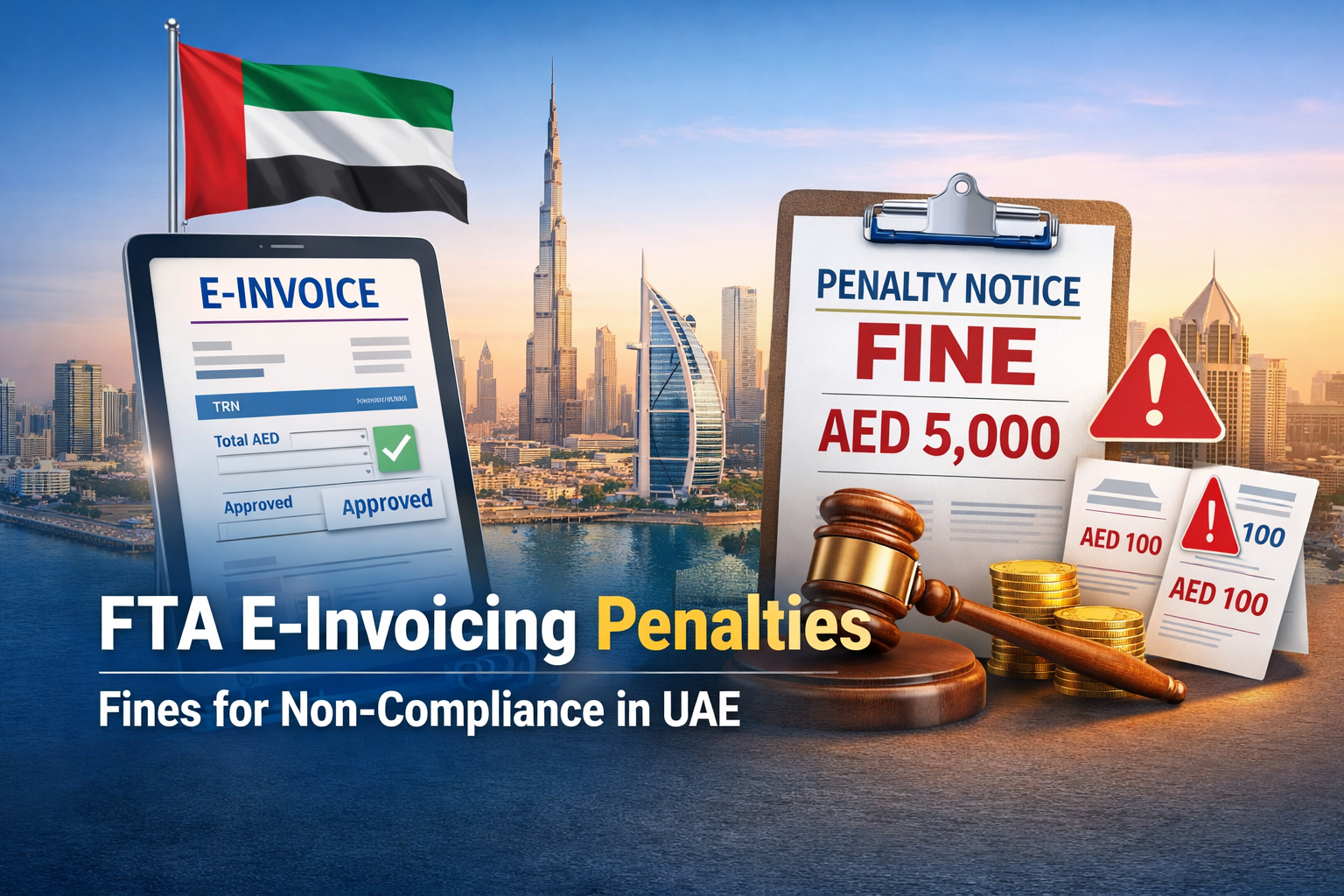
The UAE Cabinet has formally set out administrative penalties for e-invoicing violations under Cabinet Decision No. 106 of 2025. These fines are designed to enforce timely adoption and proper use of the e-invoicing system. Here are the key penalties businesses will face for non-compliance:
- Failure to Implement E-Invoicing / No ASP Appointed: If a company does not implement the e-invoicing system or fails to appoint an approved ASP by the deadline, the fine is AED 5,000 for each month of delay (or part thereof). In other words, missing the compliance date will cost AED 5,000 per month until you get on board.
- Not Issuing Electronic Invoices: Once it’s mandatory, every VAT invoice must be issued through the e-invoicing platform. If you continue to issue invoices outside the system (e.g. giving only a paper or PDF invoice), the penalty is AED 100 per invoice not sent electronically, capped at AED 5,000 per month. Each non-compliant invoice or “missed” e-invoice counts, but the monthly cap limits this to 5,000 AED max per month for invoice violations.
- Not Issuing Electronic Credit Notes: Similarly, credit notes must be issued through the system. Failing to issue an electronic credit note (for returns, discounts, etc.) carries AED 100 per credit note, capped at AED 5,000 per month. (Credit notes are treated separately, so they have their own AED 5k monthly cap in penalties in addition to the invoice cap.)
- Failure to Notify FTA of System Failures: If the e-invoicing system experiences a technical failure or outage that prevents you from issuing invoices, you are required to inform the FTA within a set timeframe (the Minister has specified within 2 business days of the occurrence). Failing to promptly report a system malfunction to the FTA will incur AED 1,000 for each day of delay (or part of a day). These daily fines keep adding up until you notify the authorities of the issue.
- Failure to Notify Your ASP of Data Changes: Businesses must also notify their chosen ASP of any changes to the company’s registered details (for example, changes in your tax registration info) within the prescribed time. If you don’t inform your ASP of changes to your registered data in time, the penalty is AED 1,000 per day of delay. This ensures your service provider and the FTA always have up-to-date information about your business.
These fines may be applied cumulatively if multiple violations occur. For instance, a company that hasn’t onboarded the system on time and also keeps issuing non-compliant invoices could be fined for both infractions simultaneously. The penalty amounts are significant – AED 5,000 per month for delays and up to AED 5,000 per month for invoices can quickly add up, especially for SMEs. The AED 1,000 daily fines for failing to report issues underscore that even administrative lapses (like not communicating problems) can cost thousands of dirhams if not addressed immediately.
Importantly, these e-invoicing penalties will apply to all businesses in scope once their phase’s mandate kicks in. Voluntary early adopters (before their required date) won’t be fined – the fines only start once e-invoicing is officially mandatory for you. But after that, the FTA has full authority to impose these fines from day one of non-compliance. The Cabinet Decision has been published in the official gazette, meaning the penalty framework is legally in force. The message from authorities is clear: the UAE is moving toward full digital tax compliance, and businesses must issue electronic invoices through the FTA system or pay the price.
Risks of Ignoring the E-Invoicing Mandate
Aside from the direct fines, ignoring the e-invoicing timeline comes with serious business risks – financial, reputational, and legal. First and foremost, the financial impact can be substantial. Fines of AED 5,000 per month for implementation delays and AED 100 per invoice will cut into your profits. If you have high invoicing volumes, those AED 100 penalties (up to 5k monthly) basically become a recurring tax on your non-compliance. Over a year, a company could easily incur tens of thousands of dirhams in fines – a needless expense that directly affects your bottom line.
There’s also the risk of escalating enforcement. The FTA has indicated there might be an initial grace approach focused on support when the system first rolls out, but this is not a guarantee of leniency. Once the mandate is live, the penalty rules are binding, and authorities can choose to enforce them strictly from day one. Counting on a permanent “grace period” is a mistake. Businesses that remain willfully non-compliant may also draw increased scrutiny from the tax authorities. In fact, companies that fail to meet e-invoicing standards are more likely to face audits, leading to operational disruption and added compliance costs. The FTA will be able to spot non-compliance easily (since compliant firms report invoices in real-time, those not doing so will stick out), potentially triggering investigations or audits of your VAT records.
Reputational damage is another concern. Persistent non-compliance could tarnish your company’s reputation with partners, clients, and investors who value businesses that follow the law. If your buyers (especially large B2B customers or government clients) find that you aren’t issuing proper e-invoices, it could strain those relationships. In a future where most companies are seamlessly e-invoicing, being a laggard might mark your business as unreliable or high-risk. Additionally, ignoring legal mandates can have broader legal exposure. The e-invoicing requirements are part of federal tax legislation; chronic non-compliance could lead to further actions beyond fines, such as other penalties under tax procedures law, or issues renewing tax registrations or business licenses. At the very least, any unpaid fines could accumulate and result in enforcement actions to collect those penalties.
Finally, failing to implement e-invoicing can impact your VAT compliance overall. The FTA expects all in-scope invoices to be reported through the system; if you’re outside it, your VAT return filings may have discrepancies or reporting inaccuracies. This could delay VAT refunds you are owed (since the FTA might not have your invoices on record) and cause errors in your tax reporting. In summary, ignoring the mandate isn’t just deferring an IT project – it’s inviting financial losses, compliance headaches, and damage to your business’s standing. The cost of compliance will be far lower than the cost of non-compliance in the long run.
How to Avoid E-Invoicing Fines
Preventing e-invoicing penalties is entirely achievable with proactive planning. Here are key steps your business can take now to avoid costly fines and ensure a smooth transition:
- Start with a Readiness Assessment: Evaluate where your company stands today. Determine which phase of the rollout you fall under and how close your current invoicing process is to the new requirements. Now is the ideal time to review internal readiness – perform a gap analysis on your accounting or ERP systems and processes against the FTA’s e-invoicing criteria. This will highlight what needs to be upgraded or changed before the deadline.
- Appoint an Accredited Service Provider (ASP) Early: Don’t wait for the last minute to choose your FTA-approved e-invoicing service provider. Selecting and onboarding an ASP is a mandatory step, so research providers and pick one well before the deadline. For Phase 1 companies, that means by mid-2026. An ASP will provide the platform that connects your invoicing system to your buyers and the FTA. Finalize your contract and integration plans with an ASP in advance. Engaging an approved provider early ensures you have time to iron out technical issues and meet the FTA’s accreditation requirements.
- Integrate and Test Your Systems: Work with your IT/ERP team to integrate your billing software or ERP with the chosen ASP’s solution. Successful e-invoicing may require software updates or modules that generate invoices in the required format (such as PINT UAE XML format). Plan for integration and thoroughly test the end-to-end workflow – from invoice creation, to sending through the ASP, to the buyer’s reception and FTA acknowledgment. Testing ahead of the go-live date will help avoid any surprises. Make sure to validate timelines for ERP connection and system testing now so that by the time e-invoicing is mandatory, everything functions smoothly.
- Train Your Staff and Update Processes: Even with good technology, your team needs to use it correctly. Provide training for your finance, accounting, and invoicing staff on the new e-invoicing process. Ensure they know how to issue invoices via the new system and what to do if any errors or system failures occur. Update your internal procedures to include steps like monitoring invoice transmissions, handling any rejection notifications, and maintaining digital records. Setting clear responsibilities and internal controls (e.g. who in finance will liaise with the ASP or respond to FTA alerts) will keep your invoicing compliant day-to-day.
- Establish a Contingency Plan: Since technical glitches can happen, have a plan for any system failures. Know the procedure for issuing invoices manually if the system is down and how to notify the FTA within 2 business days of a failure to stay on the right side of the rules. Likewise, keep your ASP updated about any changes (like if you update your TRN details or business address) to avoid those daily fines. A good ASP partner can guide you on contingency workflows and compliance reporting for outages.
- Stay Informed on FTA Updates: Compliance is not a one-and-done effort. Follow any new guidelines or clarifications the FTA releases on e-invoicing. The FTA may issue detailed technical standards or updates to the schema, new phases for B2C, etc. Being aware of the latest requirements will help you adjust in time. Regularly check the FTA or Ministry of Finance announcements, or consult with tax advisors for updates. In short, keep up with any changes so you’re never caught off guard by compliance obligations.
By taking these steps, you can significantly reduce the risk of penalties. Essentially, act early and proactively. The businesses that prepare in advance will find the transition far less disruptive. In fact, authorities encourage companies to use the voluntary adoption period (from July 2026) to their advantage – it’s a chance to get familiar with the system without penalties. Companies that implement the system on time and follow the rules will not only avoid fines but also benefit from smoother VAT operations and fewer audit headaches. The investment in compliance now is well worth avoiding a potential compliance crisis later.