UAE E-Invoicing Accredited Service Providers (ASPs): Official List, Requirements & How to Choose (2026 Guide)

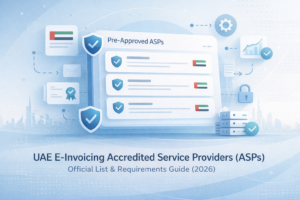
If you’re preparing for the UAE’s e-invoicing rollout, choosing the right UAE e-invoicing Accredited Service Providers (also called Accredited Service Providers (ASPs) UAE) is one of the first decisions you must make. The Ministry of Finance (MoF) and the Federal Tax Authority (FTA) are implementing an electronic invoicing system that requires invoices to be exchanged and reported in a structured format—not PDFs—through the official e-invoicing framework. From 1 July 2026, businesses can join the pilot or implement voluntarily, followed by phased mandatory compliance in 2027.That is why ASP selection is not a “later” task. It affects your ERP integration, invoice approvals, customer onboarding, and compliance risk from day one. What Is an Accredited Service Provider (ASP) in UAE E-Invoicing? An Accredited Service Provider (ASP) is a service provider that is approved by the MoF to provide electronic invoicing services under the UAE e-invoicing system. In practical terms, an ASP sits between your business and your buyers/suppliers to enable secure invoice exchange and reporting through the official framework. What an ASP actually does (day-to-day) A good ASP typically supports the full e-invoicing lifecycle: The MoF defines an e-invoice as structured invoice data exchanged electronically and reported to the FTA—and explicitly states that PDFs, Word files, images, scanned copies, and emails are not e-invoices. Why Are ASPs Mandatory Under UAE E-Invoicing Regulations? ASPs are mandatory because the UAE e-invoicing system is designed as a regulated ecosystem, not a simple “send invoices by email” upgrade. 1) It’s a legal requirement tied to implementation deadlines The UAE’s implementation decision sets clear obligations for businesses to appoint an Accredited Service Provider by specific dates depending on revenue thresholds and phase. 2) The system depends on real-time, standardised data exchange The UAE framework is built on a Peppol interoperability approach and national requirements (including PINT AE and a Data Dictionary) to standardise invoice data exchange and reporting. 3) Non-compliance carries defined penalty exposure Cabinet Decision No. 106 of 2025 includes penalties for failing to implement the system, including failure to appoint an ASP within the required timeline, and penalties for failing to issue/transmit electronic invoices and for not reporting system failures on time. For UAE SMEs and larger enterprises alike, the takeaway is simple: if you’re in scope, you cannot “DIY” e-invoicing outside the official framework once your phase becomes mandatory. Official UAE E-Invoicing Accredited Service Providers (ASP) List Where the official list is published The official source for e-invoicing programme information is the MoF eInvoicing portal, which includes a dedicated section for Pre-Approved eInvoicing Service Providers.  The MoF “Pre-Approved eInvoicing Service Providers” page states that: Important: “Pre-approved” vs “Accredited” In the UAE framework, “pre-approval” is a provisional stage; final accreditation is granted under the accreditation process and timeline determined by the MoF. Note: Because the official ASP list is updated periodically, always verify directly through the MoF portal before selecting or contracting an ASP.  Key Requirements to Become an Accredited Service Provider in UAE If you want to understand what “accredited” really means, Ministerial Decision No. 64 of 2025 outlines the eligibility criteria and ongoing requirements. Here are the key requirements in plain English (high-level summary): This matters because it helps you separate “general invoicing software” from a provider that is genuinely aligned with UAE e-invoicing compliance 2026. How to Choose the Right ASP for Your Business in UAE There is no one “best ASP” for everyone. The right choice depends on your invoice volumes, ERP landscape, and your industry (retail vs construction vs trading). 1) Match the ASP to your business size and complexity SMEs usually need: Enterprises (multi-entity, multi-ERP, high volume) usually need: 2) Confirm ERP compatibility before you sign Your priority should be ERP e-invoicing UAE readiness: 3) Ask about scalability and peak-load performance In Dubai and Abu Dhabi, many businesses have seasonal spikes (retail campaigns, construction milestones, tender cycles). Ensure the ASP can handle: 4) Understand the cost structure Request a clear breakdown: 5) Prioritise local UAE support When something fails, you need fast answers. Ask: Quick selection checklist (use this internally) What to check Why it matters Listed on MoF official ASP list Avoid non-compliant vendors and rework  PINT AE / Peppol alignment Ensures structured invoice compliance and interoperability ERP integration method (API vs portal) Determines automation level and internal workload Testing environment (sandbox) Prevents go-live failures and invoice rejections Archiving and audit trail Supports UAE audit readiness and internal controls Clear pricing model Avoid surprises when volumes increase Common Mistakes Businesses Make When Selecting an ASP These are the mistakes we see most often in the UAE market: UAE E-Invoicing Timeline & ASP Deadlines (2026–2027) Ministerial Decision No. 244 of 2025 sets the key phases and deadlines. High-level timeline The same decision also notes that B2C transactions are not yet subject until determined by a future decision. Penalties for Not Using an Accredited Service Provider The UAE has a specific penalty schedule for e-invoicing violations under Cabinet Decision No. 106 of 2025. How Our E-Invoicing Solutions Help You Stay ASP-Compliant  We help UAE businesses prepare for e-invoicing in a practical, low-stress way—without overpromising or forcing a one-size-fits-all approach. Here’s how we typically support you:

DCTCE 2026 UAE: Dubai & Abu Dhabi E-Invoicing Compliance Steps

DCTCE 2026 UAE: What Dubai and Abu Dhabi Businesses Must Do Now DCTCE 2026 UAE is the UAE’s biggest shift in business tax operations since VAT launched. Starting in 2026, the UAE e-invoicing program moves into pilot/voluntary adoption and then into phased mandatory compliance. If you issue invoices in Dubai or Abu Dhabi—whether you’re a retailer, contractor, logistics operator, wholesaler, or professional services firm—this change affects your billing, ERP, approvals, customer onboarding, and VAT risk. The UAE has selected a Decentralised Continuous Transaction Control and Exchange (DCTCE) model using the Peppol network and the Peppol International Invoice Template (PINT) as the UAE data dictionary foundation.Practically, this means PDF invoices won’t qualify as e-invoices once the mandate applies, and invoices must move in a structured format via UAE Accredited Service Providers (ASPs). What is DCTCE UAE, in simple terms? DCTCE is a model where invoice exchange and tax data reporting happen through a network of certified providers, rather than a single central government portal that clears each invoice before it reaches your customer. The UAE framework is described as a “5-corner model”: The UAE Ministry of Finance explains that the program leverages OpenPeppol for interoperability, enabling invoices to be exchanged inside the UAE and, over time, beyond borders. Why Dubai and Abu Dhabi companies should start now (not in 2026) 1) Compliance is not only “tax”—it’s system readiness DCTCE is a finance + IT + operations project. Even if your VAT filing is clean today, e-invoicing introduces: Businesses that wait often end up doing rushed integrations, manual workarounds, and “broken” workflows that delay cash collection. 2) Penalties are now real and public In late 2025, multiple public updates highlighted a UAE penalty framework for noncompliance with e-invoicing rules.The details and enforcement approach can evolve, but the direction is clear: deadlines will be enforced, and businesses should treat e-invoicing as a compliance priority. 3) Customers will push you In Dubai and Abu Dhabi, larger buyers—especially groups with centralized procurement—will want suppliers who can: If your invoices fail a buyer’s requirements, you get delayed payments even if you “did everything else right.” DCTCE 2026–2027 UAE timeline: what to plan for The clearest public summary (also echoed by major advisory firms) shows a phased rollout tied to revenue thresholds: If you’re in Dubai/Abu Dhabi and close to the AED 50m threshold (or part of a group), plan like a “large business” until you confirm your scope—because the time lost in scope debate is usually more expensive than early readiness. How Peppol works in the UAE (what the “5-corner” model means for you) The practical flow Why this matters for Dubai & Abu Dhabi The structured invoice standard: PINT-AE (what it is and why it matters) The UAE has published/pointed to PINT-AE (United Arab Emirates billing specification) under the Peppol PINT methodology.Advisory summaries note PINT-AE provides detailed invoice fields, validation rules, and which fields are mandatory/conditional/optional depending on scenario. What you should take away: What must Dubai and Abu Dhabi businesses do now? (Action plan) Step 1: Confirm your scope and entity map Do this first because it drives timelines and budget: Step 2: Appoint an internal “e-invoicing owner” This is not optional. Assign one accountable owner (usually Finance) and one technical owner (IT/ERP), with weekly checkpoints. DCTCE touches invoicing, approvals, customer onboarding, master data, and audit trails. Step 3: Audit your invoicing systems (the “source of truth” check) Dubai and Abu Dhabi businesses often have multiple invoice sources: Make a single list of every system that can create an invoice today. Anything “manual” is a red flag under structured e-invoice rules. Step 4: Choose your integration approach with an ASP The UAE framework references UAE Accredited Service Providers as key participants in the system. Most companies fall into one of these paths: If you’re issuing high volume invoices (common in Dubai trading + Abu Dhabi distribution), API is usually the end goal. Step 5: Fix master data before you “build” PINT-AE compliance lives and dies on master data: Do a master data cleanup sprint early. It’s the fastest way to reduce future rejections. Step 6: Update invoice business rules and exception handling Define what happens when: Step 7: Run a sandbox pilot before July 2026 (ideally) The public program indicates a pilot starting 1 July 2026 with voluntary adoption available.If you test earlier (with your vendor/ASP), you’ll avoid last-minute chaos. Technical checklist: what your ERP and process must support Different businesses will implement differently, but most will need: A note on items like QR codes or digital signatures: requirements can differ by jurisdiction and invoice type. In the UAE Peppol-based model, rely on the latest MoF/FTA guidance and your ASP’s implementation playbook for what is required in your exact scenario. Dubai & Abu Dhabi industry examples: what changes in real life Retail & e-commerce (Dubai malls, Abu Dhabi retail groups) Construction & contracting (projects, variations, retention) Logistics & freight Professional services (consulting, legal, accounting) Wholesale & distribution Cost drivers and integration challenges (what to budget for) Common cost buckets: Common challenges to watch: Benefits beyond compliance (why smart companies treat this as a transformation) When implemented well, DCTCE readiness can deliver: Better reporting and future-ready “real-time visibility” mindset (what MoF highlights as richer invoice data for analysis)

UAE E-Invoicing 2026: Your Complete FTA Compliance Roadmap

Introduction: Why UAE E-Invoicing 2026 Matters Now From July 2026, UAE e-invoicing 2026 moves from a future idea to a real obligation for businesses across Dubai, Abu Dhabi, Sharjah and the wider Emirates. The Ministry of Finance (MoF) and the Federal Tax Authority (FTA) are rolling out a nationwide electronic invoicing system built on the DCTCE UAE model and the Peppol network.  Instead of paper or PDF invoices, companies will have to issue a structured e-invoice UAE in a standard PINT-AE format, transmit it through accredited service providers, and share key tax data with the FTA in near real time. This guide explains, in practical language: 1. What UAE E-Invoicing 2026 Actually Means 1.1 From PDFs to structured e-invoices Under the new system, an invoice is only considered an e-invoice if it is: Traditional PDFs and paper documents will not satisfy the e-invoicing mandate UAE once it becomes mandatory. 1.2 Who must comply? According to current guidance, the system will apply mainly to: Some sources also note that non-VAT registered entities involved in B2B/B2G transactions may be brought into scope via their service providers, so everyone dealing with tax invoices should pay attention.  2. Why You Must Prepare Early 2.1 Penalties and enforcement risk The MoF has already issued a penalty framework for electronic invoicing non-compliance, with fines for failures such as not using the system correctly, missing data, or ignoring notification rules. Recent reports show penalties up to AED 5,000 per violation for issues around invoices, credit notes and system notifications, on top of existing VAT penalties. Leaving preparations too late can lead to: 2.2 System and process challenges Moving to ERP e-invoicing UAE is not a one-week IT task. You’ll need to: Failure to plan early may mean: 2.3 Cash-flow and reputation If your invoices fail FTA validation UAE or are not accepted by customers’ systems, you simply don’t get paid. Over time, customers will prefer suppliers who are consistently compliant and easy to deal with. 3. FTA Roadmap: 2026–2027 in Plain Language The current public roadmap looks roughly like this: Even though full enforcement starts in 2027, 2026 is when the real work happens. Treat 2026 as your implementation year, not a waiting period. 4. Understanding the DCTCE UAE and Peppol 5-Corner Model 4.1 What is DCTCE UAE? The UAE has chosen a Decentralised Continuous Transaction Control and Exchange (DCTCE) model.  In simple terms: This model balances control for the tax authority with flexibility for businesses. 4.2 The Peppol 5-corner flow The five-corner model in the UAE looks like this:  Because both sides use Peppol-compliant ASPs, a supplier in Dubai can send a structured e-invoice UAE that a buyer’s system in Abu Dhabi, Sharjah, or even overseas can process automatically. 5. Technical Rules: What a Structured E-Invoice UAE Must Contain 5.1 PINT-AE format and structure The UAE has adopted PINT-AE, a localized version of the Peppol International Invoice Template (PINT). Key points: For most businesses, the practical message is: Your ERP must be able to export invoices in PINT-AE-compliant XML (or via an ASP that can convert them for you). 5.2 Core data fields While the full data dictionary is extensive, most e-invoices must include at least: Many guides also reference digital signatures and QR codes as part of the framework, especially for authentication and B2C flows. However, some recent technical commentaries clarify that no extra QR code or signature beyond Peppol’s built-in security may be required for standard PINT-AE invoices. Because these details can evolve, your safest approach is to: 5.3 How FTA validation works in practice In the DCTCE model, FTA validation UAE usually happens in two layers:  If validation fails, the ASP normally returns the invoice for correction before it ever reaches the customer. 6. System Changes You’ll Need (ERP E-Invoicing UAE) 6.1 ERP readiness Whether you use SAP, Oracle, Microsoft Dynamics, Tally, Zoho, or another system, you will likely need to:  For smaller businesses using basic accounting tools, a cloud e-invoicing solution can act as the missing link between your system and the DCTCE model. 6.2 ASP onboarding All e-invoices must move through a UAE Accredited Service Provider.  When choosing an ASP, consider: This is where a specialized platform can give you a single connection for all customers, suppliers and FTA reporting. 6.3 Data standardisation Many problems in e-invoicing come from poor master data. Before 2026, clean up: Consistent data means higher automation, fewer rejections and faster reconciliation. 6.4 Internal controls and people Technology is only part of the story. You’ll also need to: 7. Step-by-Step FTA Compliance Roadmap (Dubai, Abu Dhabi, Sharjah & Beyond) Step 1: Confirm your scope and deadlines Step 2: Assess your current invoicing process Document: This gap analysis shows how far you are from FTA e-invoicing compliance. Step 3: Select an ASP and integration model Decide whether you will: For high-volume businesses, automated ERP e-invoicing UAE is usually best; SMEs may start with a portal and upgrade later. Step 4: Clean and standardise master data Before any test: Step 5: Implement and test PINT-AE output Work with your ASP and ERP vendor to: Step 6: Train teams and update procedures Provide training for: Update internal SOPs to include DCTCE steps and fallback procedures if systems go down. Step 7: Join the 2026 pilot or voluntary phase Whenever possible, start in the July 2026 pilot/voluntary phase before e-invoicing becomes mandatory. This gives you: 8. Industry Examples: How Different Sectors Are Affected 8.1 Retail and e-commerce Retailers often issue thousands of invoices daily. With UAE e-invoicing 2026: 8.2 Construction and contracting Construction businesses in Dubai and Abu Dhabi handle complex contracts, retention, and staged billing: 8.3 Logistics and distribution Logistics and distribution companies issue frequent invoices for freight, warehousing, and customs handling: 8.4 Professional services Consulting, legal, and advisory firms often work on retainers and time-based billing: 8.5 Wholesale and trading Wholesalers dealing with supermarkets, pharmacies, or electronics chains can benefit from: 9. Costs, Integration Challenges and Mistakes to Avoid 9.1 Main cost drivers Your total cost of UAE e-invoicing 2026 will depend on: For most businesses, the ongoing ASP and integration costs are offset by lower manual work, fewer errors, and reduced penalties. 9.2 Common integration challenges Typical issues include: 9.3 Mistakes to avoid Avoid these frequent errors: A structured roadmap and early testing help you avoid last-minute chaos.

How Smart E-Invoicing Will Shape the Future of Business Compliance in the UAE

From July 2026 onwards, e-invoicing will start becoming a normal part of doing business in the UAE, not just a “nice-to-have”. The Ministry of Finance (MoF) and the Federal Tax Authority (FTA) are rolling out a Peppol-based, real-time e-invoicing system that will gradually become mandatory for many VAT-registered businesses. For UAE companies, this is not only a technical change. It’s a business compliance revolution. In simple terms: This is where smart e-invoicing UAE comes in. It’s not just “sending invoices electronically”. It’s using automation, real-time checks, and analytics to make UAE business compliance faster, more accurate, and easier to manage. 1. What Is Smart E-Invoicing in the UAE? 1.1 From PDFs to structured e-invoices Today, many businesses still send invoices as PDFs, email attachments, or even paper. Under the new FTA e-invoicing requirements, those formats will no longer count as e-invoices. According to the UAE Ministry of Finance, an e-invoice is: So instead of a flat PDF, a smart e-invoice is typically in XML/UBL format, following a standard model (like PINT AE) that machines can read, validate, and process instantly. 1.2 What makes it “smart”? “Smart” e-invoicing is more than just generating XML. A smart e-invoicing system UAE typically offers: The result: fewer errors, fewer rejected invoices, and a much easier path to UAE business compliance. 2. The UAE E-Invoicing System: Where We Are and What Changes in 2026 2.1 Legal and regulatory foundation The UAE has been preparing the ground for years: All of this supports a move to a standardized, digital tax compliance UAE framework where invoices are issued electronically and reported to the FTA in near real time. 2.2 Timeline: 2026 and beyond Current guidance from official publications and leading tax advisors shows a phased rollout: Exact dates and waves can evolve, so businesses should track updates on the MoF/FTA portals and official decisions. But what is clear is that e-invoicing will not stay optional for long. 2.3 The Peppol-based 5-corner model The UAE has adopted a Decentralized Continuous Transaction Control and Exchange (DCTCE) model based on Peppol, often described as a “five-corner” setup: Invoices move through certified Peppol Access Points, which validate and transform data into the UAE standard, while tax data is reported to the FTA in parallel. This gives businesses a secure connection to their trading partners and gives the FTA real-time tax reporting UAE without forcing everyone onto a single government portal. 3. How Smart E-Invoicing Will Transform Business Compliance 3.1 Real-time digital tax compliance UAE Under traditional systems, you: With smart e-invoicing: That means fewer surprises during audits, fewer corrections, and a smoother path to UAE business compliance. 3.2 Stronger audit trails and reduced fraud Because every e-invoice in the new system is: It becomes much harder to: Authorities and auditors can rely on complete, traceable data, which significantly improves VAT compliance and fraud detection. 3.3 Lower risk of penalties The introduction of e-invoicing will be accompanied by specific penalties for non-compliance – for example, not issuing structured e-invoices when required, or failing to report them correctly. Smart e-invoicing systems help you avoid this by: In other words, technology becomes your first line of defense against costly mistakes. 3.4 Alignment across VAT, corporate tax, and more The same accurate transaction data that powers e-invoicing can support: The UAE is moving towards a fully digital tax ecosystem, where high-quality invoice data is a shared foundation across multiple obligations. 4. Smart E-Invoicing Features That Will Matter Most by 2026 To take full advantage of the new e-invoicing system UAE, you’ll want more than “bare minimum” compliance. Here are the key features to look for in a smart e-invoicing UAE solution. 4.1 Real-time validation and structured invoice formats Your solution should: This ensures that the FTA and the buyer’s system accept your invoices on the first try. 4.2 Native Peppol UAE connectivity Because the UAE is building its framework on Peppol, your provider should act as (or connect to) a certified Peppol Access Point. Benefits: If you trade internationally, this is crucial for the digital invoicing future UAE is aiming toward. 4.3 Deep ERP and business system integration For real business automation UAE, smart e-invoicing must connect to your existing tools: A good solution should: This eliminates manual data entry and reduces human error. 4.4 Workflow automation and approvals Smart e-invoicing tools can automate: This ensures your UAE business compliance rules are followed consistently without relying on memory or email chains. 4.5 Smart analytics and dashboards A future-ready platform should give you: This turns compliance data into cash-flow and risk insights, helping management make better decisions. 4.6 Secure, paperless invoicing UAE and digital archiving Look for: This supports both paperless invoicing UAE goals and your internal security policies. 5. Real-World Examples: How 2026 Might Look in Practice To make this more concrete, let’s imagine a few scenarios under the new system. 5.1 A large retailer in Dubai A retail group runs multiple stores, operates an ERP, and issues thousands of B2B invoices every month. With smart e-invoicing: Result: 5.2 A mid-sized professional services firm A consulting company issues monthly retainers and project invoices to clients across the UAE. Under a smart system: This streamlines digital tax compliance UAE for a business that doesn’t have a huge finance team but must still manage multiple regulations (VAT, corporate tax, etc.). 5.3 An importer/exporter using Peppol UAE A trader imports goods into the UAE and exports to other Peppol-enabled markets. With smart e-invoicing and Peppol: This improves both compliance and operational efficiency across borders. 6. Risks of Falling Behind on Smart E-Invoicing Ignoring or delaying preparation for the e-invoicing system UAE comes with real risks. 6.1 Financial penalties and blocked invoices Non-compliance with FTA e-invoicing requirements is likely to attract: If your invoices are not accepted in the system, customers may not be able to claim input VAT, and they may refuse to pay until you fix the problem. 6.2 Higher audit exposure If your invoicing is mostly manual: In a world where the FTA sees near real-time data from many businesses, companies still relying on manual processes can stand out as high-risk. 6.3 Lost competitive advantage Early adopters of smart e-invoicing UAE will: Late adopters will struggle with fragmented systems while their competitors enjoy a smoother, automated environment. 7. A Step-by-Step Roadmap to Prepare for 2026 Here’s a practical, future-focused plan you can start now. Step 1: Map your

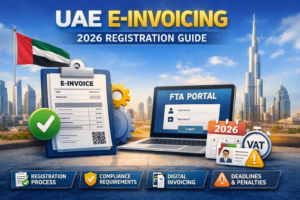
Step-by-Step Guide to UAE E-Invoicing Registration (2026 Edition)

The UAE is entering a new era of digital tax compliance, where traditional paper invoices and unstructured PDF files will no longer be sufficient. Beginning in July 2026, all VAT-registered businesses must issue, transmit, and store invoices digitally in compliance with the Federal Tax Authority (FTA) e-invoicing regulations and the Digital Tax Compliance Environment (DCTCE). This shift is part of the UAE’s ongoing digital transformation to enhance transparency, improvetax compliance, and streamline financial operations for businesses of all sizes. If you are a business owner, accountant, or finance professional in the UAE, understanding how to register for UAE e-invoicing is critical. This comprehensive step-by-step guide will cover everything you need to know about e-invoicingregistration, system requirements, compliance procedures, common mistakes, and practical tips to ensure your business is fully prepared for the July 2026 mandate. What is UAE E-Invoicing and Why It Matters All VAT-registered businesses, suppliers to government entities, and entities involved in self-billing arrangements are required to comply. Non-compliance can result in penalties, fines, and rejection of invoices, making early preparationcrucial. Who Must Register for UAE E-InvoicingThe FTA has clarified which businesses must register for e-invoicing: Step 8: Go Live with Official E-InvoicesOnce testing is complete, businesses can start issuing official e-invoices. All invoices must now: Step 10: Maintain Compliance and Monitor Updates Compliance is ongoing. Businesses must: Benefits of UAE E-Invoicing RegistrationImplementing e-invoicing UAE provides numerous advantages: Common Mistakes to Avoid Avoiding these mistakes ensures smoother registration and compliance. Preparation Checklist for Businesses Timeline for UAE E-Invoicing Businesses are encouraged to start preparation now to avoid last-minute complications.

Understanding Peppol and Its Role in UAE E-Invoicing Compliance

Introduction The United Arab Emirates is moving toward one of the most advanced digital tax frameworks in the world. Starting July 2026, every VAT-registered business will be required to exchange structured e-invoices through a regulated, secure, andstandardised system. This major shift—part of the Digital Tax Control and E-Invoicing System (DCTCE)—will replace traditional PDF or paper invoices with automated and authenticated digital documents. At the core of this transformation is Peppol, a global network used by governments and businesses to exchange electronic documents in a consistent and secure way. Although Peppol originated in Europe, it has quickly become a trusted global standard for cross-border trade, compliance, and digital invoicing. The UAE is now integrating Peppol into its national e-invoicing framework to ensure that every transaction is transparent, traceable, and aligned with international best practices. What Is Peppol? A Simple Explanation for UAE BusinessesPeppol (Pan-European Public Procurement Online) is a global network that allows companies to exchange structured digital documents—such as e-invoices, purchase orders, and credit notes—in a secure and standardised manner. Instead of sendingPDF invoices by email and manually entering figures into accounting systems, Peppol allows systems to “talk” to each other automatically. Why Peppol Is Important Why the UAE Is Adopting Peppol for E-InvoicingThe UAE government aims to create a digital, transparent, and secure business environment. Peppol helps achieve these goals by introducing: Structured invoice formats The UAE’s e-invoicing compliance model—known as PINT AE—is built on the Peppol framework but adapted for local laws and FTA requirements. With Peppol, the UAE ensures that its e-invoicing system is: Understanding the Peppol 5-Corner Model (UAE Version)Traditionally, Peppol used a 4-corner model, but the UAE is adopting a more advanced 5-corner model to support validation, compliance monitoring, and real-time document exchange. Corner 1: The Sender (Supplier)The business issuing the invoice. They generate the structured e-invoice using their ERP, accounting software, or e-invoicing platform. Corner 2: The Sender’s Peppol Access Point A certified Access Point in the UAE that: Corner 5: The Receiver (Buyer)The business receiving the invoice. They get a fully validated, compliant, andvstructured document ready for automated processing in their accounting system. What Is PINT AE? Understanding the UAE’s Local Peppol Format PINT AE (Peppol International Invoice for the UAE) is the official format for e-invoices under UAE law. It is based on Peppol BIS Billing 3.0 but adapted to include: UAE VAT rules How Peppol Supports UAE E-Invoicing ComplianceBelow are the key ways Peppol enhances UAE e-invoicing: Format integrityThis ensures every invoice meets FTA e-invoicing requirements. Benefits of Peppol for UAE Businesses UAE E-Invoicing Timeline (What You Should Expect) 2025 – Early PreparationBusinesses start testing systems, exploring Access Points, and training teams. July 2026 – Mandatory E-Invoicing BeginsAll VAT-registered companies must issue and receive structured e-invoices. 2027 – Expected Real-Time ReportingBusinesses will transmit invoices to the tax system instantly (similar to Saudi ArabiaPhase 2). How UAE Businesses Can Prepare for Peppol and DCTCE 2026Here is a step-by-step preparation checklist:

Role of Accredited Service Providers in UAE E-Invoicing | Compliance Guide

Understanding the Importance of ASPs in UAE E-InvoicingThe UAE government is moving steadily toward a fully digital invoicing environment — one where every business invoice is generated, exchanged, and reported electronically. A key part of this shift is the requirement to work via an Accredited Service Provider (ASP) under the e-invoicing system. When you grasp the role of an ASP in UAE e-invoicing, you’ll understand how using the right provider helps you stay compliant, avoid penalties, and streamline your billing operations. What Is an Accredited Service Provider (ASP)?Accredited Service Provider (ASP) is a third-party platform that has been certified by the Ministry of Finance (MoF) of the UAE to handle e-invoice validation, exchange, and reporting.Under the UAE e-invoicing framework, businesses cannot simply issue invoices directly to the authorities — they must route them through an ASP that ensures all technical, security, and compliance standards are met.In effect, an ASP acts as a bridge between your billing system and the Federal Tax Authority (FTA) — helping you follow the required structured formats, digital signatures, Peppol network connections, and real-time tax data reporting. Why an ASP Matters for Your BusinessChoosing the right ASP matters for several reasons: Compliance AssuranceASPs ensure your invoices meet all technical and legal requirements of the UAE e-invoicing system — from structured formats (XML/UBL) to secure transmission and storage. The relevant regulation is Ministerial Decision No. 64 of 2025, which sets up eligibility criteria and rules for service providers.Using a certified ASP reduces risk of invoice rejections, penalties or audit issues. Technical Integration & Efficiency ASPs help you interface your existing accounting or ERP system with the digital invoicing flow. They handle tasks like data mapping, digital signature implementation, real-time validation and secure exchange — which means you don’t have to build everything from scratch. Data Security & ReportingSince your e-invoices and tax data must be stored securely and made available for audits, the ASP’s security, archiving and reporting capabilities become critical. The ASP ensures that invoices are encrypted, time-stamped, stored for the required retention period, and their submission can be traced reliably. Key Responsibilities of an ASP in the UAE E-Invoicing FrameworkAn ASP must fulfill several responsibilities. Here are the most important ones: Invoice Validation and ExchangeWhen you issue an invoice, the ASP checks it against the required standards (structured data, signature, required fields, correct TRN, etc.). If it passes, the ASP sends it from your endpoint to the buyer’s endpoint and reports relevant tax data tothe FTA. Tax Data Reporting to the FTAThe ASP is responsible for transmitting the Tax Data Document (TDD) to the FTA and making sure the message status is confirmed. This allows immediate traceability of your invoices for tax compliance. Security, Archiving & RetentionASPs must securely archive e-invoices in the required digital format for the required retention period (typically five years or more), ensure encryption, manage access controls and make sure the processes meet ISO and other security standards. Ongoing Monitoring & Accreditation RenewalAn ASP must maintain its accreditation status, undergo regular checks or audits, renew its certification, and keep up with evolving technical standards. As a business using an ASP, you should ensure your provider is up-to-date. How to Choose the Right ASP for Your BusinessSelecting the right ASP is vital. Here are practical criteria to evaluate: Compatibility with Your Systems Ensure the ASP supports integration with your accounting/ERP setup, can handle your invoice volume, and connects seamlessly to the Peppol network used in the UAE. Proven AccreditationCheck that the provider is officially listed as an Accredited Service Provider by the MoF and meets the eligibility conditions (Peppol certification, minimum years of experience, ISO standards). Security & Compliance Credentialsencryption standards, business continuity processes, and audit trail capabilities. The ASP must demonstrate data security, integrity and regulatory readiness. Support, Training & OnboardingThe ASP should provide implementation support, staff training, and ongoing assistance — especially during the transition phase from manual or semi-manual invoicing to full digital format. Clear SLAs and ReportingAsk about response times, uptime guarantees, invoice rejection handling, reporting dashboards, visibility into message status and tax data reporting. Your business operations depend on consistent reliability. Common Business Challenges When Working with an ASP — and How to Overcome ThemEven with a certified ASP, businesses often face three key issues. Here’s how totackle them: Challenge: Legacy Systems and Data GapsOlder billing systems may not output invoices in the required structured format (XML/UBL), or lack required fields like line-item details, TRN, etc.Solution: Conduct a systems audit, identify data gaps, map your existing invoice fields to the e-invoicing data dictionary and work closely with the ASP during onboarding to fill missing fields and automate conversions. Challenge: High Invoice Volume and PerformanceIf a business issues thousands of invoices hourly, delays or failures in the ASP link can disrupt operations.Solution: Choose an ASP that offers bulk upload, batch processing, real-time monitoring, and can scale with your volume. Run load tests and check their current client base for similar volumes. Challenge: Compliance Readiness and TimingWaiting until the deadline can lead to last-minute scrambling, system downtime and increased risk of non-compliance.Solution: Start early, sign up with an ASP well in advance, complete test phases, integrate systems, and simulate your invoice flow before full rollout. Use the ASP’s onboarding, support and testing resources to be ready ahead of mandates. Timeline & Regulatory Context of ASPs in the UAE The UAE’s move towards mandatory e-invoicing includes a phased implementation timetable. Businesses must align accordingly: Benefits of Partnering with an Accredited Service Provider Action Steps Your Business Can Take Right Now Final ThoughtsThe rise of e-invoicing in the UAE represents a major leap toward digital taxcompliance and operational efficiency. Accredited Service Providers (ASPs) sit at theheart of this transformation — bridging your internal systems with the national taxinfrastructure.By selecting the right ASP, integrating early, and aligning your processes, youposition your business to benefit from smoother operations, stronger compliance,and better financial control.

Top E-Invoicing Challenges in the UAE – And How to Overcome Them

As the UAE continues its move toward mandatory e-invoicing, many businesses are discovering that compliance isn’t as simple as flipping a switch. From technical issues to understanding FTA requirements, several challenges can arise—especially for companies that are still using manual or outdated systems. At Virtual Accountants LLC, we’ve worked with hundreds of UAE businesses navigating the shift to digital invoicing. Here’s a look at the top e-invoicing challenges companies face—and how we help overcome them: 1. Lack of Technical Knowledge Many businesses struggle to understand how e-invoicing systems work or how to connect them with existing accounting software.✅ Our solution is plug-and-play, with no coding or IT teams required. 2. Errors in VAT Calculation Manual entries often result in miscalculations, leading to rejected invoices or incorrect filings.✅ We provide built-in VAT automation aligned with UAE laws to ensure accuracy. 3. Compliance with FTA Format & Guidelines Invoices must meet specific formatting rules and include bilingual content (Arabic-English).✅ Our platform generates FTA-compliant, bilingual invoices with all required fields. 4. Integration with Existing Systems Many businesses find it difficult to sync e-invoicing tools with their ERP, CRM, or bank accounts.✅ Our system integrates seamlessly with top ERPs and UAE banking systems. 5. Keeping Up with Regulations The FTA’s rules and deadlines are evolving, making it hard for businesses to stay current.✅ We automatically update our platform to align with all UAE tax changes. E-invoicing doesn’t have to be complicated. With Virtual Accountants LLC, you get a partner who understands the local market and is committed to making your compliance journey smooth and stress-free. Start your transition today—and turn challenges into opportunities for smarter, faster invoicing.

Embracing E-Invoicing Automation in the UAE: A Smarter Way to Do Business

Digital transformation is reshaping the business landscape in the UAE, and at the forefront of this evolution is e-invoicing. As mandated by the UAE Federal Tax Authority (FTA), e-invoicing is not only a regulatory requirement — it’s also a powerful tool to boost efficiency, transparency, and cost savings. Manual invoicing is time-consuming, prone to errors, and can lead to costly delays in VAT reporting. On the other hand, automated e-invoicing systems streamline the entire process — from invoice creation and delivery to real-time validation and submission to the FTA. At Virtual Accountants LLC, we empower businesses across the UAE with a fully automated, FTA-compliant e-invoicing solution. Our platform is designed to eliminate the burden of manual data entry, reduce human error, and keep your business always ready for audits and reporting deadlines. Here’s how e-invoicing automation benefits your business: Whether you’re dealing with a high volume of invoices or simply want to future-proof your financial operations, automation is the key. With our solution, you can spend less time managing paperwork and more time growing your business. The UAE is setting the pace for digital tax transformation. Let Virtual Accountants LLC help you stay ahead with smart, reliable, and scalable e-invoicing tools built for your success. Contact us today to get started on your journey toward effortless e-invoicing compliance.

UAE E-Invoicing Compliance: Why It Matters and How Virtual Accountants LLC Can Help

As the UAE moves toward a fully digital tax system, e-invoicing has become a crucial requirement for VAT-registered businesses. Under the Federal Tax Authority (FTA), companies must now issue and report invoices electronically, ensuring accuracy, transparency, and real-time compliance with tax regulations. E-invoicing is more than just a trend — it’s a legal mandate that offers significant benefits. From reducing manual errors and preventing tax evasion to improving cash flow and speeding up payments, this digital shift is reshaping how businesses manage their finances in the UAE. At Virtual Accountants LLC, we offer a robust, FTA-compliant e-invoicing solution tailored to meet the unique needs of businesses operating in the UAE. Our platform ensures 100% alignment with government regulations while making the entire invoicing process faster, easier, and more secure. Key features include: Whether you’re a small startup or a large enterprise, Virtual Accountants LLC ensures your business stays audit-ready and ahead of compliance deadlines. Our solution not only streamlines invoicing but also enhances your overall financial reporting and operational efficiency. With phase-wise implementation of e-invoicing in progress, now is the time to act. Don’t wait for compliance to become a challenge — turn it into a competitive advantage with the right tools and support. Ready to simplify your e-invoicing journey?Get in touch with Virtual Accountants LLC today and ensure your business stays compliant, efficient, and future-ready.